The Shape Language of Data
The mean tells you where the center of your data sits. The standard deviation tells you how spread out the values are. These two numbers summarize most distributions well enough for everyday use — but they say nothing about shape.
Shape matters. A distribution can be symmetric or lopsided, can have thin tails or thick ones, can have most of its weight near the center or concentrated in the extremes. Two datasets with identical means and standard deviations can behave completely differently in practice. According to the NIST/SEMATECH Engineering Statistics Handbook, the third and fourth standardized moments — skewness and kurtosis — are the primary tools for detecting departures from normality and for understanding the shape of a distribution beyond its center and spread.
What is Skewness? (Direction of Data Asymmetry)
Skewness Symbol (γ₁ / g₁)
Skewness uses two symbols depending on whether you are working with a population or a sample:
In most academic writing you will see γ₁ for the population parameter and g₁ for the sample statistic. Excel's SKEW(), Python's scipy.stats.skew(), and SPSS all compute g₁ (the bias-corrected sample version) by default.
Skewness and Kurtosis Formulas
The formula for skewness expresses it as the third standardized moment. Take every value's deviation from the mean, cube it (which preserves the sign, unlike squaring), average those cubed deviations, and divide by the cubed standard deviation to make the result unitless. The cube operation is what gives skewness its directional sensitivity.
g₁ = sample skewness
n = sample size
xᵢ = each data point
x̄ = sample mean
s = sample standard deviation
β₂ = raw kurtosis (normal = 3)
β₂ − 3 = excess kurtosis (normal = 0)
n = sample size
s = sample standard deviation
Most statistical software — including SPSS and Excel's SKEW() function — uses the Fisher–Pearson formulation for skewness. The correction factor n / ((n−1)(n−2)) matters most for small datasets. For large samples it approaches 1 and the simpler population formula gives essentially the same result.
A skewness value between −0.5 and +0.5 is generally considered approximately symmetric. Values between ±0.5 and ±1.0 indicate moderate skewness. Values beyond ±1.0 indicate substantial skewness that materially affects how you should interpret the mean. These thresholds are conventions, not laws — always look at a histogram alongside the number.
Types of Skewness and Kurtosis
Both skewness and kurtosis have three named types based on the direction or magnitude of their values relative to the normal distribution baseline.
Positive Skew (Right-Skewed Data)
Long tail extends right
Most data clusters on the left; a smaller number of very high values stretches the distribution rightward. The mean is pulled above the median.
Mean > Median > Mode
The extreme values in the right tail inflate the mean. The median is a more reliable summary of a typical value in this case.
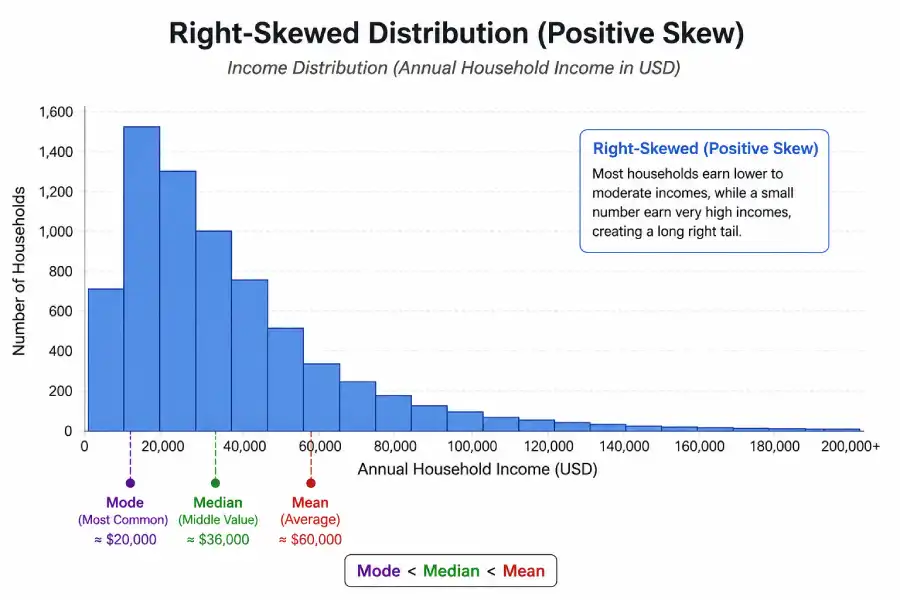
Income distribution in most countries shows clear positive skewness. The majority of households earn near the median — for the United States, the Census Bureau reports a consistent 20–25% gap between mean and median household income because a smaller number of very high earners pulls the mean upward. Other common examples include housing prices, wealth distribution, and waiting times for rare events.
U.S. Household Income (Positive Skew)
According to the U.S. Census Bureau's Current Population Survey, the 2023 mean household income was approximately $105,000 while the median was around $77,000 — a gap of nearly $28,000. This difference is a direct consequence of the right-skewed income distribution. The mean is being pulled upward by households earning several hundred thousand dollars or more per year. The median better represents what a randomly selected household actually earns.
Negative Skew (Left-Skewed Data)
Long tail extends left
Most data clusters on the right; a smaller number of very low values pulls the distribution leftward. The mean falls below the median.
Mean < Median < Mode
The extreme low values in the left tail drag the mean downward. The median resists this distortion.

Negatively skewed distributions appear wherever there is a natural ceiling. Human lifespan in high-income countries is left-skewed: most people survive into their 70s or 80s, while a smaller number die young and pull the mean below the most common life expectancy. Easy exam scores — where most students score in the 80s and 90s — produce the same shape.
Zero Skew (Symmetry)
A skewness of zero describes a distribution that is perfectly symmetric around its mean. The normal distribution is the most familiar example: its bell curve is a mirror image on either side of the mean, and mean = median = mode all sit at the same point.
A dataset can have zero skewness while being far from normally distributed. A perfectly bimodal distribution (two equal humps on either side of the center) has zero skewness but is obviously not normal. Skewness tests symmetry; it does not test normality. Use the Shapiro–Wilk test or a Q-Q plot for normality assessment.
What is Kurtosis? (Tail Intensity of Data)
Kurtosis Symbol (β₂ / g₂)
Kurtosis also uses Greek-based symbols that differ between population and sample contexts:
The normal distribution has a raw kurtosis (β₂) of 3. Most software reports excess kurtosis (raw kurtosis minus 3), so the normal distribution's reference value is 0. Excel's KURT() function, Python's scipy.stats.kurtosis() by default, and SPSS all report excess kurtosis. When a research paper says "kurtosis = 0.5" they almost certainly mean excess kurtosis.
Kurtosis is widely described as measuring the "peakedness" of a distribution. This is incorrect. As statistician Peter Westfall demonstrated in a 2014 paper in The American Statistician, kurtosis is driven almost entirely by tail behavior, not by the shape of the peak. A distribution can be flat-topped and still have high kurtosis if its tails are fat enough.
Leptokurtic Distribution (Heavy Tails, Positive Kurtosis)
Heavier tails than normal
Extreme values occur more often than a normal distribution would predict. The distribution has more observations in its tails and near its center relative to the shoulders. In practice this means outliers are not rare events — they happen with meaningful regularity.
Daily stock market returns are the textbook example of leptokurtosis. Financial economists have known since Benoit Mandelbrot's 1963 research that stock return distributions have significantly heavier tails than the normal distribution. Crashes and rallies that a normal model would call "6-sigma events" appear in real markets every decade — the so-called "fat tail" problem.
Platykurtic Distribution (Light Tails, Negative Kurtosis)
Lighter tails than normal
Extreme values are less common than the normal distribution predicts. More of the distribution's mass sits in the shoulders rather than the tails. Outcomes are more uniformly distributed — the data doesn't wander very far from the center as often as a bell curve would suggest.
The uniform distribution (where every outcome in a range is equally likely) is the clearest example of a platykurtic distribution, with excess kurtosis of −1.2. Rolling a single fair die produces a uniform distribution: each face appears with equal probability and the outcome never strays in any unusual way. Quality-controlled manufacturing processes often produce platykurtic output distributions.
Mesokurtic (Normal Baseline)
A mesokurtic distribution has excess kurtosis equal (or approximately equal) to zero — its tails behave like the normal distribution. The normal distribution itself is the reference case. IQ scores, heights, and many measurement errors approximate this shape on large samples.
Difference Between Skewness and Kurtosis
These two measures are frequently confused — partly because both describe departures from the normal distribution, and partly because the words "shape" and "distribution" appear in explanations of both. The distinction is exact and worth memorizing:
Two Different Lenses on the Same Distribution
Skewness — The Direction Lens
Asks: "Which way does the data lean?" It measures asymmetry — whether the distribution is pulled toward higher values (right), lower values (left), or neither. It is derived from the third moment. A positive result means the right tail is longer; a negative result means the left tail is longer.
Kurtosis — The Tail Lens
Asks: "How extreme are the extremes?" It measures tail weight — how often the distribution produces values far from the mean. It is derived from the fourth moment. A positive excess kurtosis means outliers are more common than in a normal distribution; a negative value means they are rarer.
These two properties are independent. Any combination is possible. The table below provides a detailed eight-dimension comparison:
| Dimension | Skewness (γ₁ / g₁) | Excess Kurtosis (β₂−3 / g₂) |
|---|---|---|
| Core purpose | Measures asymmetry — left/right lean of the distribution | Measures tail heaviness — how common extreme values are |
| Statistical moment | Third standardized moment | Fourth standardized moment |
| Normal distribution baseline | 0 (perfectly symmetric) | 0 in excess form; 3 in raw form |
| Positive values mean | Right tail is longer (right-skewed); mean > median | Heavier-than-normal tails (leptokurtic); more outliers |
| Negative values mean | Left tail is longer (left-skewed); mean < median | Lighter-than-normal tails (platykurtic); fewer outliers |
| Primary application | Choosing between mean and median as center measure | Risk modeling, outlier frequency, normality assumption checking |
| Practical implication | High skewness → report median, not mean | High kurtosis → normal-based models underestimate tail risk |
| Real-world example | Income distribution (positive); exam scores on easy test (negative) | Stock returns (positive leptokurtic); uniform die rolls (negative platykurtic) |
Student's t-distribution with 5 degrees of freedom is perfectly symmetric (zero skewness) but substantially leptokurtic — this confirms that skewness and kurtosis measure genuinely different things.
How to Interpret Skewness and Kurtosis Values
Once you have computed skewness and kurtosis values, you need benchmark ranges to judge whether they indicate a problem. The thresholds below reflect conventions used across statistics, social science, finance, and data science. No universal cutoffs exist — always use judgment alongside the numbers and check a histogram.
Acceptable Range of Skewness and Kurtosis
| Value Range | Skewness Interpretation | Recommended Action |
|---|---|---|
| |g₁| < 0.5 | Approximately symmetric | Mean is a reliable center measure; most parametric tests safe to proceed |
| 0.5 ≤ |g₁| < 1.0 | Moderate skewness | Check histogram; mean may overstate or understate typical value; consider reporting median alongside |
| |g₁| ≥ 1.0 | Substantial skewness | Report median as primary center measure; consider log or square-root transformation before modeling |
| |g₁| ≥ 2.0 | Severe skewness | Distribution requires transformation or non-parametric methods; normality assumption likely violated |
| Excess Kurtosis Range | Kurtosis Interpretation | Recommended Action |
|---|---|---|
| |g₂| < 1.0 | Approximately mesokurtic | Tail behavior similar to normal; standard parametric methods appropriate |
| 1.0 ≤ g₂ < 3.0 | Moderate leptokurtosis | Check for outliers; use robust standard errors in regression; consider t-distribution for modeling |
| g₂ ≥ 3.0 | Strong leptokurtosis | Normal-based risk models substantially underestimate tail probability; use fat-tail distributions |
| g₂ < −1.0 | Platykurtic | Tails lighter than normal; extreme values rarer than expected; uniform-like distribution |
Social science and psychology often use |skewness| < 2 and |excess kurtosis| < 7 as acceptable ranges for parametric tests (George & Mallery, 2010). Finance is more conservative — any excess kurtosis above 1 is typically flagged in risk modeling. Educational measurement uses ±2 for both. Check the conventions of your specific field.
How to Interpret Skewness and Kurtosis: Worked Examples
Seven annual bonuses paid to employees: $2,000 / $2,500 / $3,000 / $3,200 / $3,500 / $4,000 / $18,000
Calculate the mean: (2000 + 2500 + 3000 + 3200 + 3500 + 4000 + 18000) / 7 = 36,200 / 7 ≈ $5,171
Find the median: Sorted, the middle value (4th of 7) is $3,200
Compare: Mean ($5,171) > Median ($3,200). The mean is being pulled right by the $18,000 bonus.
Interpret: The dataset is positively (right) skewed. Using the range table above — skewness ≈ 1.7 falls in the "substantial" range. The median of $3,200 is the better central measure.
✓ Positive skewness (g₁ ≈ 1.7). Mean ($5,171) substantially overestimates typical earnings. Median ($3,200) is the more informative central measure here. Reporting the mean without noting the skewness would be misleading.
Two investment portfolios report the same annualized mean return and standard deviation, but different distributions of monthly returns.
Portfolio A: Monthly returns are tightly clustered around the mean. No single month produced a return more than 2 standard deviations from average. Excess kurtosis = −0.8 (platykurtic).
Portfolio B: Most months produce modest returns close to the mean, but three months in the past five years produced losses greater than 4 standard deviations below the mean. Excess kurtosis = +8.2 (strongly leptokurtic).
Both portfolios share the same mean and standard deviation. Looking only at those two numbers, the portfolios appear equally risky.
Interpret kurtosis: Portfolio B (g₂ = 8.2) falls in the "strong leptokurtosis" range. Extreme losses are not black swan events — they are a predictable feature of its return distribution.
✓ Kurtosis reveals what standard deviation hides. A risk manager evaluating only mean and SD would treat these portfolios as equivalent. The kurtosis difference signals that Portfolio B requires different risk management — options-based hedging or more conservative position sizing.
How to Report Skewness and Kurtosis (APA Format)
Academic and clinical research routinely requires reporting skewness and kurtosis alongside descriptive statistics. APA style requires both the values and their standard errors — which are derived from the sample size.
Standard Error of Skewness and Kurtosis (SES / SEK)
Standard Error of Skewness (SES):
Standard Error of Kurtosis (SEK):
Normality z-score test (skewness):
Example APA table format (n = 100):
| Variable | M | SD | Skewness | SE | Kurtosis | SE |
|---|---|---|---|---|---|---|
| Exam score | 72.4 | 11.3 | −0.84 | 0.24 | 0.52 | 0.48 |
| Response time (ms) | 423 | 87 | 1.24 | 0.24 | 2.17 | 0.48 |
Note: SES = √(6/100) = 0.245; SEK = √(24/100) = 0.490. Values rounded to 2 decimal places per APA 7th edition.
In the body text of a results section you would write: "Descriptive statistics revealed that response time was positively skewed (skewness = 1.24, SE = 0.24), with the skewness z-score of 5.17 indicating significant departure from symmetry at p < .001. The distribution was leptokurtic (kurtosis = 2.17, SE = 0.48)."
Real-World Distribution Analysis
Case Study 1 — Salary Distribution
Case Study
Income Inequality: High Positive Skew, High Kurtosis
The distribution of individual annual incomes in most market economies shows two pronounced characteristics simultaneously: strong positive skewness (the right tail extends to multi-million-dollar incomes) and high excess kurtosis (extreme incomes, both very high and occasionally very low, are more common than a normal distribution predicts).
Median income is the standard measure of living standards precisely because positive skewness makes the mean a poor representative of the typical worker's experience. Meanwhile, the heavy upper tail — captured by kurtosis — is what drives Gini coefficient calculations and top-income-share statistics.
Case Study 2 — Stock Market Returns
Case Study
Financial Risk: Near-Zero Skew, Very High Kurtosis
Daily stock index returns are roughly symmetric in direction (skewness close to zero), but strongly leptokurtic — both very large gains and very large losses happen far more often than a normal distribution would predict. This is the "fat tails" property documented extensively in financial econometrics since the 1960s.
The practical implication is that Value-at-Risk (VaR) models built on normal distribution assumptions underestimate extreme losses. Research by Campbell, Lo, and MacKinlay documented that daily S&P 500 returns have an excess kurtosis of approximately 7–12, depending on the time period — meaning a normal model underestimates the probability of a single-day loss greater than 4 standard deviations by roughly 100×.
Case Study 3 — Exam Score Distribution
Case Study
Exam Scores: Varying Skew, Near-Normal Kurtosis
Exam score distributions change shape depending on test difficulty. On a well-calibrated exam, scores approximate a normal distribution (zero skewness, zero excess kurtosis). On a very easy exam, scores cluster near the top, producing negative skewness. On a very difficult exam, scores cluster near the bottom, producing positive skewness.
This matters for grading decisions. When a class's exam scores are negatively skewed, applying a strict normal curve to assign grades penalizes students unfairly — the distribution does not fit the assumption. Using the mean as the central benchmark fails in skewed score distributions.
Skewness and Kurtosis Calculator
Enter your comma-separated data below. The calculator computes sample skewness (Fisher–Pearson), excess kurtosis, and their standard errors (SES / SEK) for any dataset with three or more values. Results also show the APA normality z-scores.
Skewness & Kurtosis Calculator
How to Calculate Skewness and Kurtosis
Manual calculation using the definitions above is tedious for large datasets but straightforward for small ones. The steps below use a five-value dataset to show each moment calculation explicitly.
Calculate sample skewness and excess kurtosis for the values: 2, 4, 6, 8, 20
Mean (x̄): (2 + 4 + 6 + 8 + 20) / 5 = 40 / 5 = 8.0
Standard deviation (s): Deviations from mean: −6, −4, −2, 0, 12. Squared deviations: 36, 16, 4, 0, 144. Sum = 200. Sample variance = 200/(5−1) = 50. s = √50 ≈ 7.071
Standardized values [(xᵢ − x̄)/s]: −0.849, −0.566, −0.283, 0.000, 1.697
Cubed standardized values for skewness: −0.611, −0.181, −0.023, 0.000, 4.876. Sum = 4.061
Sample skewness: g₁ = [n/((n−1)(n−2))] × Σz³ = [5/(4×3)] × 4.061 = 0.4167 × 4.061 ≈ 1.69
✓ Skewness g₁ ≈ 1.69 — substantial positive skew, driven by the outlier value of 20. Excess kurtosis g₂ ≈ 2.41 (leptokurtic), indicating heavier tails than normal. SES = √(6/5) ≈ 1.10; skewness z-score = 1.69 / 1.10 ≈ 1.54 (not significant at n=5 — too small a sample to draw firm conclusions).
Alternative Skewness Formulas (Galton, Pearson 2)
The Fisher–Pearson formula is the most common, but two alternative measures are worth knowing for situations where the standard formula is sensitive to outliers:
| Formula | Definition | When to Use |
|---|---|---|
| Fisher–Pearson (g₁) | [n/((n−1)(n−2))] × Σ[(xᵢ−x̄)/s]³ | Default in most software; general use |
| Galton skewness (Bowley's) | (Q3 + Q1 − 2×Q2) / (Q3 − Q1) | Resistant to outliers; uses quartiles Q1, Q2 (median), Q3 |
| Pearson 2 coefficient | Sk₂ = 3(mean − median) / s | Quick approximation; useful when only M, Mdn, and SD are reported |
Galton (Bowley's) skewness is particularly useful when your data has extreme outliers that dominate the standard formula. Since it is based on quartiles rather than all data points, a single extreme value cannot distort the result. The NIST Handbook covers this measure in depth for exploratory analysis of robust shape assessment.
Jarque-Bera Test: Combining Skewness and Kurtosis
The Jarque-Bera (JB) test is the most common formal statistical test that uses both skewness and kurtosis simultaneously to test whether a sample comes from a normal distribution. It is widely used in economics and finance as a diagnostic before model fitting.
n = sample size
S = sample skewness (g₁)
K = excess kurtosis (g₂)
JB > 5.99 → reject normality at α = .05
A large JB value (or small p-value against the chi-squared distribution with 2 df) means the data departs significantly from normality due to its combined skewness and/or kurtosis. If either skewness or kurtosis is large, the test rejects. In Python: scipy.stats.jarque_bera(data); in R: tseries::jarque.bera.test(data).
Skewness and Kurtosis in Machine Learning / EDA
In exploratory data analysis (EDA) and machine learning workflows, checking skewness and kurtosis is a standard pre-processing step. Here is the typical decision logic:
Checking skewness and kurtosis before fitting a model
Compute shape statistics: Calculate g₁ (skewness) and g₂ (excess kurtosis) for every numeric feature. Flag any with |g₁| > 1 or |g₂| > 2.
Apply transformation if needed: For right-skewed features (g₁ > 1): try log(x+1) or square root. For left-skewed features: try reflecting and then log. Box-Cox transformation automatically finds the optimal power parameter λ to minimize skewness.
Re-check after transformation: Recompute skewness and kurtosis. Most good transformations reduce |g₁| below 1 and bring |g₂| below 3.
Algorithm sensitivity: Linear models (OLS, logistic regression), LDA, and distance-based algorithms (k-NN, k-means) are sensitive to skewness and kurtosis. Tree-based methods (Random Forest, XGBoost) are generally robust to both — transformation is less critical for them.
✓ Skewness and kurtosis are part of the standard EDA checklist alongside missing values, correlations, and outlier detection. Libraries: df.skew() and df.kurtosis() in pandas give column-wise shape statistics in one call.
Skewness and Kurtosis in Software
Kurtosis of Common Probability Distributions
The table below shows the skewness and excess kurtosis for 12 named distributions. This makes it easier to identify which distribution might model your data based on observed shape statistics.
| Distribution | Skewness | Excess Kurtosis |
|---|---|---|
| Normal distribution | 0 | 0 |
| Uniform distribution | 0 | −1.2 (platykurtic) |
| Exponential distribution | 2.0 (right-skewed) | 6.0 (leptokurtic) |
| Student's t (5 df) | 0 (symmetric) | 6.0 (leptokurtic) |
| Student's t (10 df) | 0 (symmetric) | 2.0 (leptokurtic) |
| Student's t (30 df) | 0 (symmetric) | 0.43 (slightly leptokurtic) |
| Log-normal (σ=1) | 6.18 (strongly right-skewed) | 110.9 (extreme leptokurtosis) |
| Beta(2,5) | 0.60 (right-skewed) | −0.26 (slightly platykurtic) |
| Beta(5,2) | −0.60 (left-skewed) | −0.26 (slightly platykurtic) |
| Weibull (k=1.5) | 0.64 (right-skewed) | 0.07 (approximately mesokurtic) |
| Cauchy distribution | Undefined | Undefined (tails too heavy) |
| Bernoulli (p=0.5) | 0 | −2.0 (platykurtic) |
The Cauchy distribution is notable: its tails are so heavy that neither the mean, variance, skewness, nor kurtosis are defined in the traditional sense. The log-normal distribution with σ=1 shows extreme values for both statistics — which is why log-normal is used to model income and stock prices (which exhibit exactly these properties in real data).
Reading Histograms for Skewness and Kurtosis
Before computing any formula, a good histogram usually reveals the shape of your data. Here is what to look for:
| Histogram Pattern | Skewness | Kurtosis |
|---|---|---|
| Symmetric, moderate peak | ≈ 0 | ≈ 0 (excess) |
| Longer right tail, peak shifted left | > 0 (positive) | Varies |
| Longer left tail, peak shifted right | < 0 (negative) | Varies |
| Very tall sharp peak, long thin tails | ≈ 0 | > 0 (leptokurtic) |
| Flat, wide, no pronounced peak | ≈ 0 | < 0 (platykurtic) |
| Two humps, roughly equal | ≈ 0 | < 0 (platykurtic or bimodal) |
A Q-Q (quantile-quantile) plot complements skewness and kurtosis numbers: points bowing above the line indicate right skewness; S-shaped curves indicate kurtosis departures. The numbers tell you how much; the plot tells you where. For formal normality testing, use the Shapiro–Wilk test or normality tests overview.
From Beginner to Advanced: A Progressive Learning Path
Level 1 — Beginner: What Shape Means in Data
At the beginner level, the most important takeaway is that the mean and standard deviation do not fully describe a distribution. When someone tells you the average salary at a company is $90,000, you cannot judge whether that number is representative without knowing whether the distribution is skewed. If five executives each earn $1,000,000 and fifty employees each earn $50,000, the mean is pulled to $90,909 — but it describes no one's actual salary well.
Level 2 — Intermediate: Interpreting Shape in Datasets
At the intermediate level, the focus shifts to diagnosis. When you load a dataset and prepare to build a model or run a hypothesis test, checking skewness and kurtosis is part of the EDA workflow. Many statistical tests — including the one-sample t-test and ANOVA — assume that residuals are normally distributed. Substantial skewness or excess kurtosis is a signal that this assumption may need testing or that a transformation might be appropriate.
Level 3 — Advanced: Kurtosis and Risk Modeling
At the advanced level, kurtosis becomes a central concern in any model involving tail risk. Value-at-Risk (VaR) and Expected Shortfall (ES) — the two standard measures of market risk — are calculated from the tails of a return distribution. A model that assumes normality will assign incorrect probabilities to extreme outcomes. Modern approaches use distributions that explicitly accommodate non-zero kurtosis, including the Student's t-distribution and extreme value theory (EVT) models. (BIS: Minimum capital requirements for market risk)
Entity and Concept Glossary
| Concept | Formula / Symbol | Interpretation | Real-World Meaning | Common Mistake |
|---|---|---|---|---|
| Skewness | g₁ = Σ[(xᵢ−x̄)/s]³ × n/((n−1)(n−2)) | Direction of data asymmetry | Income inequality, exam score shape | Confusing it with spread (standard deviation) |
| Kurtosis (excess) | β₂ − 3; normal = 0 | Tail heaviness relative to normal | Financial crash probability, outlier frequency | Thinking it measures peak height (it does not) |
| Positive skew | g₁ > 0 | Right tail longer; mean > median | Wealth, housing prices, waiting times | Using the mean as "typical" in this case |
| Negative skew | g₁ < 0 | Left tail longer; mean < median | Easy exam scores, lifespan in rich countries | Ignoring the tail when reporting results |
| Leptokurtic | β₂ − 3 > 0 | Heavier tails; more extreme values | Stock returns, financial risk models | Conflating with "tall peak" |
| Platykurtic | β₂ − 3 < 0 | Lighter tails; fewer extremes | Uniform distributions, precision manufacturing | Assuming low kurtosis means low variance |
| Mesokurtic | β₂ − 3 ≈ 0 | Tail weight similar to normal | Height, IQ scores at population scale | Assuming mesokurtic = normally distributed |
| SES | √(6/n) | Standard error of skewness | Used in APA reporting and normality z-scores | Omitting from APA results tables |
| SEK | √(24/n) | Standard error of kurtosis | Used in APA reporting and normality z-scores | Omitting from APA results tables |
| Jarque-Bera test | JB = (n/6)(S² + K²/4) ~ χ²(2) | Tests normality using both skewness and kurtosis | Pre-model diagnostic in econometrics and finance | Using it on very small samples (n < 30) |
| Galton skewness | (Q3 + Q1 − 2Q2) / (Q3 − Q1) | Quartile-based skewness resistant to outliers | Exploratory analysis when outliers are suspected | Using it when tails (not outliers) are the concern |
| Fat tails | High positive excess kurtosis | Extreme values more probable than normal | Market crashes, insurance losses | Underestimating tail probability using normal models |
Frequently Asked Questions
Key References Used in This Guide
NIST/SEMATECH e-Handbook of Statistical Methods: Section on Skewness and Kurtosis — the primary technical reference for both measures.
Westfall, P.H. (2014): "Kurtosis as Peakedness, 1905–2014. R.I.P." The American Statistician, 68(3), 191–195. Documents the peer-reviewed evidence that kurtosis is a tail measure, not a peak measure.
DeCarlo, L.T. (1997): "On the Meaning and Use of Kurtosis." Psychological Methods, 2(3), 292–307. (APA PsycNet)
Groeneveld, R.A. & Meeden, G. (1984): "Measuring Skewness and Kurtosis." The Statistician, 33(4), 391–399. Covers alternative definitions and their properties.