What Are Descriptive Statistics? (Definition)
Descriptive statistics are methods used to summarize, organize, and describe the main features of a dataset. They turn raw numbers into clear, interpretable insights about center, spread, and shape — without making predictions or drawing conclusions beyond the data itself.
Unlike inferential statistics, which use sample data to generalize about a larger population, descriptive statistics only describe what you already have in front of you. Every serious data analysis begins here.
A descriptive statistic in the singular sense is a single summary value — a mean, a percentage, a standard deviation — that quantitatively describes a feature of a collection of data. Descriptive statistics in the plural sense refers to the entire process of computing and analyzing those values.
Descriptive statistics do not predict the future or test hypotheses. They describe the present dataset clearly so better decisions and deeper analyses can follow. Even when a study's main conclusions rely on inferential statistics, descriptive statistics are always presented alongside them.
🔑 Key Takeaways
The most important ideas in descriptive statistics at a glance.
Descriptive statistics summarize data. They turn raw numbers into clear, usable insights using measures of center, spread, and shape.
There are three main types. Central tendency, dispersion, and distribution shape — each answers a different question about your data.
Mean and median together reveal skew. When they diverge significantly, your data is skewed and the median is the better "typical" value.
Outliers distort the mean but not the median. Always check both and use IQR to detect extreme values.
Exploratory data analysis (EDA) starts here. Before any modeling or hypothesis testing, descriptive statistics reveal patterns, outliers, and data quality issues.
Types of Descriptive Statistics
Descriptive statistics are grouped into three main types. Each type answers a different question about your data, and a thorough analysis uses all three together.
| Type | Question It Answers | Key Measures |
|---|---|---|
| Central Tendency | Where does the data cluster? | Mean, Median, Mode |
| Dispersion | How spread out is the data? | Range, Variance, Standard Deviation, IQR |
| Distribution Shape | What does the pattern look like? | Skewness, Kurtosis, Percentiles |
You can also distinguish descriptive statistics by the number of variables analyzed. Univariate analysis describes one variable at a time (e.g., the mean salary in a company). Bivariate analysis describes the relationship between two variables (e.g., salary vs. years of experience), using tools like correlation, scatter plots, cross-tabulations, and contingency tables. When more than two variables are involved, it is called multivariate analysis. In bivariate work, quantitative measures of dependence such as Pearson's r (for two continuous variables) or Spearman's rho (when one or both are ordinal) describe the strength and direction of relationships.
Types of Data in Descriptive Statistics
The type of data you have determines which descriptive statistics are appropriate. See the full guide to types of data in statistics for detail, but the key distinction is:
- Quantitative (numerical) data — can be measured and arithmetic operations make sense. Divided into discrete (countable: number of patients) and continuous (any value in a range: temperature, weight). Mean, median, and standard deviation all apply.
- Qualitative (categorical) data — categories without meaningful arithmetic. Divided into nominal (unordered labels: blood type, product color) and ordinal (ordered categories: pain rating 1–5, education level). Mode and frequency distribution apply; mean does not.
In experimental research, variables are further classified as dependent (the outcome you are measuring) and independent (the variable you manipulate or observe to explain the outcome). Descriptive statistics are computed for all variables before any inferential test is run.
How to Think About Any Dataset
- 1. Where is the center? Use mean, median, or mode to find the typical value.
- 2. How spread out is the data? Use standard deviation or IQR to measure variability.
- 3. What does the shape look like? Use skewness and kurtosis to understand distribution patterns.
- 4. Are there outliers? Use the 1.5×IQR rule or a box plot to flag extreme values.
Why Descriptive Statistics Matter
Raw data rarely tells its own story. Descriptive statistics turn messy spreadsheets into something understandable. They are essential for several concrete reasons:
- Data summary: They condense large datasets into a handful of values that reveal overall characteristics at a glance.
- Data cleaning: By identifying outliers and unusual patterns, descriptive statistics expose potential errors, entry mistakes, or anomalies in the data before any analysis proceeds.
- Hypothesis generation: Patterns revealed by descriptive statistics — a bimodal distribution, a skewed variable, an unexpected mode — suggest hypotheses worth investigating further.
- Communication: They provide a standardized, audience-agnostic way to present data findings to technical and non-technical stakeholders alike.
- Foundation for advanced analysis: Descriptive statistics are always the first step before inferential statistics, regression, machine learning, or any other advanced technique.
In exploratory data analysis (EDA), descriptive statistics serve as the entry point for spotting data quality issues and deciding which advanced methods are appropriate.
Frequency Distribution
Before diving into specific measures, understand frequency distribution — how often each value (or range of values) appears in a dataset. It is typically displayed as a table, histogram, or stem-and-leaf plot.
For example, if 30 students take an exam and scores range from 60–100, a frequency distribution table might show:
| Score Range | Frequency (# of Students) | Relative Frequency |
|---|---|---|
| 60–69 | 3 | 10% |
| 70–79 | 8 | 27% |
| 80–89 | 12 | 40% |
| 90–100 | 7 | 23% |
A stem-and-leaf plot is another form of frequency display, considered more precise because it preserves individual values. The "stem" records the tens place and each "leaf" is a units digit — letting you read individual data points while still seeing the distribution pattern. For the scores 72, 75, 78, 82, 85, 88 the stem-and-leaf would show stems 7 and 8 with their respective leaves.
Frequency distributions are the starting point for histograms and help you understand the overall pattern before computing any summary measures. Try the histogram maker or the stem-and-leaf plot maker.
Measures of Central Tendency
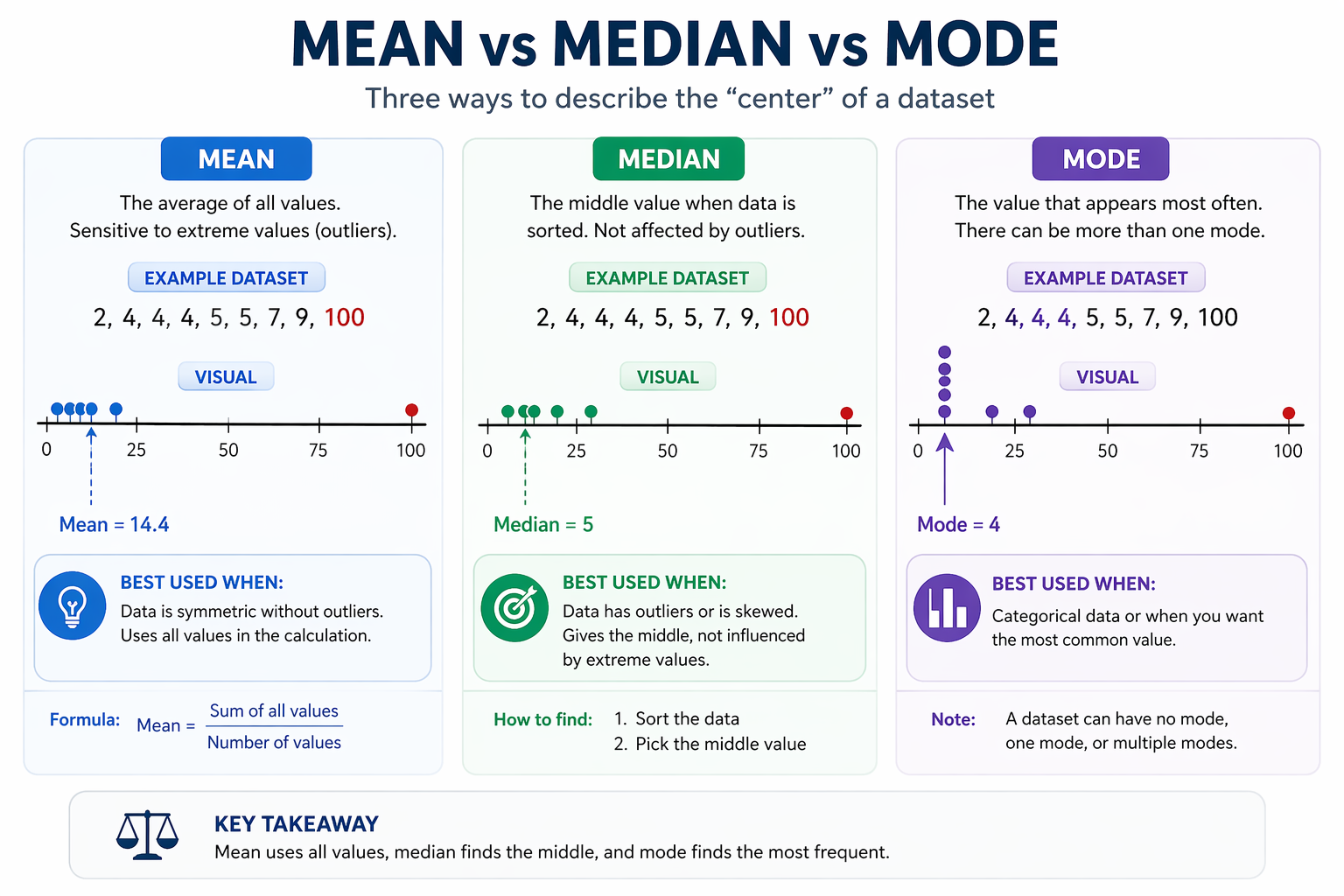
These measures show the typical or central value in a dataset. Knowing when to use each one is one of the most important skills in data analysis. See the full comparison: mean vs median vs mode.
Mean
The mean is the arithmetic average — the sum of all values divided by the count.
For a population mean use μ = Σxᵢ / N
Example — Exam Scores: 65, 72, 75, 78, 80, 82, 85, 88, 90, 95
Sum = 810 → x̄ = 810 / 10 = 81
The average score is 81. The mean works best when data is roughly symmetric with no extreme outliers. For worked examples, see mean examples.
When some values count more than others (e.g., grades weighted by credit hours), use the weighted mean instead. The weighted mean formula is: x̄_w = Σ(wᵢ × xᵢ) / Σwᵢ, where wᵢ is the weight of each value.
Median
The median is the middle value after sorting data in order. For an even number of values, it is the average of the two middle values.
Sorted scores: 65, 72, 75, 78, 80, 82, 85, 88, 90, 95
Median = (80 + 82) / 2 = 81
Original data: 65, 72, 75, 78, 80, 82, 85, 88, 90, 95 → Mean = 81, Median = 81
With outlier (95 → 200): 65, 72, 75, 78, 80, 82, 85, 88, 90, 200
Mean = 90.5 (moved 9.5 points) | Median = 81 (unchanged)
The mean uses every value and is pulled by extremes. The median depends only on middle position — making it more stable for skewed or outlier-heavy data.
For worked examples, see median examples.
Mode
The mode is the most frequently occurring value. Some datasets have no mode, one mode (unimodal), two modes (bimodal), or multiple modes (multimodal).
Shoe sizes in a class: 7, 8, 8, 8, 9, 9, 10, 11 → Mode = 8
Mode is especially useful for categorical data where mean and median don't apply — such as most popular product color, most common diagnosis, or most frequent survey response.
Measures of Dispersion (Spread)
Knowing the center is useful, but two datasets can share the same mean and behave very differently. Measures of dispersion tell you how spread out the values are. We'll use the exam dataset throughout: 65, 72, 75, 78, 80, 82, 85, 88, 90, 95.
Range
Variance
Variance measures the average squared distance of each value from the mean. Squaring removes negative signs and penalizes larger deviations more heavily.
The denominator n − 1 (Bessel's correction) corrects for underestimation when using a sample.
For a population: σ² = Σ(xᵢ − μ)² / N
Step-by-step for the exam scores (mean = 81):
- Subtract the mean from each value: (65−81)² = 256, (72−81)² = 81, (75−81)² = 36 … and so on.
- Sum all squared deviations: 256 + 81 + 36 + 9 + 1 + 1 + 16 + 49 + 81 + 196 = 726
- Divide by n − 1 = 9: s² = 726 / 9 = 80.67
The drawback of variance is that it is in squared units (e.g., "squared exam points"), which has no intuitive meaning. Standard deviation solves this. See standard deviation vs variance for the full comparison.
Standard Deviation
For the exam scores: s = √80.67 ≈ 8.98 → most scores fall within about 9 points of the mean.
A standard deviation of ~9 means a typical score deviates from the mean by about 9 points. For worked examples, see standard deviation examples. Also note that standard deviation is not the same as standard error — see standard deviation vs standard error.
Coefficient of Variation (CV)
For the exam scores: CV = (8.98 / 81) × 100% ≈ 11.1% — relatively low, meaning scores cluster fairly tightly.
A CV below 15% generally indicates low variability; above 30% indicates high variability. CV is especially useful when comparing datasets measured in different units (e.g., comparing variability in height in cm vs. weight in kg). See the coefficient of variation guide.
Interquartile Range (IQR)
For the exam scores: Q1 = 75, Q3 = 88 → IQR = 88 − 75 = 13
Outlier fences: Lower = Q1 − 1.5 × IQR = 75 − 19.5 = 55.5 | Upper = Q3 + 1.5 × IQR = 88 + 19.5 = 107.5
The IQR focuses on the middle 50% of the data, completely ignoring the top and bottom 25%. This makes it robust to outliers — the defining advantage over standard deviation for skewed data. The 1.5×IQR rule: any value below Q1 − 1.5×IQR or above Q3 + 1.5×IQR is flagged as a potential outlier. Values beyond 3×IQR from Q1 or Q3 are extreme outliers.
For the exam dataset, the upper fence is 107.5 — no values exceed this, so no outliers are present. Learn more about identifying and handling outliers, or use the outlier detector tool.
A box plot is a composite visual representation that displays the median, Q1, Q3, IQR range, whiskers (to the IQR fences), and any individual outlier points all at once. It is one of the most efficient single-chart summaries of a distribution.
Five-Number Summary
The five-number summary packages the key spread information into five values: minimum, Q1, median, Q3, and maximum. It is the foundation of every box plot.
- Minimum: 65
- Q1 (25th percentile): 75
- Median (Q2 / 50th percentile): 81
- Q3 (75th percentile): 88
- Maximum: 95
Try the five-number summary calculator or the five-number summary visualizer.
Which Measure Should You Use?
Choosing the right measure depends on the shape of your data and whether outliers are present.
- Use the mean when your data is roughly symmetric and contains no extreme outliers. It uses all values and is most statistically efficient under those conditions.
- Use the median when your data is skewed or includes outliers. Income, home prices, and hospital wait times are classic examples.
- Use the mode when working with categorical data, or when you need the most common value in a discrete distribution.
- Use standard deviation when data follows a roughly normal distribution — it is directly interpretable in the original units.
- Use IQR when data contains outliers or is not normally distributed. It focuses on the middle 50% and resists extreme values.
In practice, always look at both mean and median together. A large gap between them is a strong signal that the data is skewed — and the median is the better representative value.
Shape of the Distribution
After understanding center and spread, look at the overall pattern. The shape tells you whether values are balanced around the center or pulled in one direction.
Skewness
Skewness describes asymmetry in a distribution. It is one of the most important signals when interpreting descriptive statistics.
Rule of thumb: |g₁| < 0.5 = approximately symmetric | 0.5–1 = moderately skewed | > 1 = highly skewed
Try the skewness and kurtosis full guide for the complete formula derivation.
| Skewness Type | What It Looks Like | Mean vs Median | Common Example |
|---|---|---|---|
| Positive (right) skew | Long tail on the right | Mean > Median | Income, house prices |
| Negative (left) skew | Long tail on the left | Mean < Median | Age at retirement, test with easy ceiling |
| Symmetric (no skew) | Balanced on both sides | Mean ≈ Median | Height, IQ scores |
Practical tip: Highly skewed data can often be made more symmetric by applying a log transformation. This makes graphs easier to interpret and brings the distribution closer to normal, which is an assumption of many statistical tests.
Example: Salaries (in thousands): 45, 48, 52, 55, 60, 65, 70, 120
Mean ≈ 64.4, Median = 57.5 → positive (right) skew. The single high salary pulls the tail and the mean upward.
Kurtosis
Kurtosis describes how heavy the tails are relative to a normal distribution — and how peaked or flat the center is.
g₂ = 0 → mesokurtic (normal) | g₂ > 0 → leptokurtic (heavy tails) | g₂ < 0 → platykurtic (light tails)
Most software (Excel, R, Python) reports excess kurtosis by default.
- Leptokurtic (high/positive excess kurtosis): sharp peak, heavy tails — more extreme values than a normal distribution. Common in financial return data.
- Mesokurtic (excess kurtosis ≈ 0): the standard normal bell curve.
- Platykurtic (negative excess kurtosis): flatter peak, lighter tails — fewer extreme values.
Percentiles and Quartiles
Percentiles divide a sorted dataset into 100 equal parts and show where a value stands relative to the rest. The p-th percentile is the value below which p% of the observations fall.
- Q1 (25th percentile): 25% of values fall below this point
- Q2 (50th percentile / median): middle value — 50% fall below
- Q3 (75th percentile): 75% of values fall below this point
- 90th percentile: 90% of values fall below — commonly used in performance benchmarking
- 80th percentile: 80% of values fall below — frequently referenced in test scoring and health metrics
What does the 80th percentile mean? A score at the 80th percentile means the person scored higher than 80% of others in the group. What does the 90th percentile mean? A value at the 90th percentile sits above 90% of all observations — indicating high performance or an extreme value depending on context. Percentiles are used everywhere: standardized test rankings, income distribution, pediatric growth charts, and server response time monitoring.
How to Interpret Descriptive Statistics
Calculating numbers is only half the job. Knowing what those numbers mean is where real analysis begins. Here is a systematic approach.
Step 1: Compare Mean and Median
If mean ≈ median → the data is roughly symmetric.
If mean > median → positive (right) skew. A few high values are pulling the average up.
If mean < median → negative (left) skew. A few low values are pulling the average down.
Step 2: Evaluate Spread in Context
A standard deviation is only meaningful relative to the mean. Use the coefficient of variation (CV = s / x̄ × 100%). CV below 15% = low variability; above 30% = high variability. For skewed data or when outliers are present, use IQR instead of SD. See the standard deviation visualizer.
Step 3: Apply the Empirical Rule for Normal Data
For roughly normal data, the empirical rule (68-95-99.7 rule) tells you:
- ~68% of values fall within 1 SD of the mean
- ~95% fall within 2 SDs
- ~99.7% fall within 3 SDs
Step 4: Flag Outliers with the IQR Rule
Calculate the lower fence (Q1 − 1.5 × IQR) and upper fence (Q3 + 1.5 × IQR). Any value outside these is a potential outlier. Outliers can indicate data entry errors, measurement problems, or rare genuine events. See how to handle outliers in data analysis.
Step 5: Read Skewness Values
- Skewness between −0.5 and +0.5 → approximately symmetric
- Skewness between ±0.5 and ±1 → moderately skewed
- Skewness beyond ±1 → highly skewed; prefer median and IQR over mean and SD
Try It Yourself
Dataset: 12, 15, 15, 18, 20, 22, 25
Work through these before checking:
- What is the mean?
- What is the median?
- What is the mode?
- What is the range?
- What does the mean vs median comparison suggest about skewness?
Use the descriptive statistics calculator to verify your answers instantly.
Population vs Sample Statistics
Descriptive statistics can be computed for an entire population (every member of a group) or a sample (a subset). The distinction matters for formulas — and most real-world analyses work with samples.
| Concept | Population | Sample |
|---|---|---|
| Mean symbol | μ (mu) | x̄ (x-bar) |
| Standard deviation symbol | σ (sigma) | s |
| Variance denominator | N | n − 1 (Bessel's correction) |
| When to use | You have data on everyone | You have a subset; most real-world cases |
The sample formula uses n − 1 because samples tend to underestimate population variability. Subtracting 1 corrects for this. See population vs sample statistics for the full explanation with examples.
Descriptive vs Inferential Statistics
Descriptive statistics describe the data you have. Inferential statistics use a sample to draw conclusions about a larger population — through confidence intervals, hypothesis tests, and regression. Descriptive statistics are always presented first, even when inferential statistics are the primary goal (for example, a clinical trial always includes a table of participant demographics before reporting results).
| Aspect | Descriptive Statistics | Inferential Statistics |
|---|---|---|
| Goal | Describe what the data shows | Draw conclusions about a population |
| Focus | Current dataset | Generalization from sample |
| Requires probability theory | No | Yes |
| Typical tools | Mean, SD, IQR, skewness | Confidence intervals, hypothesis tests |
| Next steps | – | Hypothesis Testing, Confidence Intervals |
Visualizing Descriptive Statistics
Numbers alone can be hard to interpret. Visualizations make patterns immediately visible. The most common visual tools for descriptive statistics are:
- Histograms — show frequency distribution across value ranges, revealing shape at a glance. Try the histogram maker.
- Box plots — display the five-number summary, IQR, and outliers simultaneously. Try the box plot generator.
- Stem-and-leaf plots — preserve individual data values while showing distribution. Try the stem-and-leaf plot maker.
- Scatter plots — reveal relationships between two numerical variables. Try the scatter plot maker.
- Bar charts and pie charts — summarize categorical frequency distributions.
- Cross-tabulations (contingency tables) — for bivariate analysis of two categorical variables, showing joint frequencies across all combinations.
Explore all interactive tools on the visual tools page and the data visualization guide.
Real-World Uses of Descriptive Statistics
- Business: Retail teams track average daily sales, sales variance, and customer purchase distributions to inform inventory and pricing decisions. For example, a company with a mean order value of $45 but a standard deviation of $60 likely has a few very large orders skewing the mean — the median order of $32 tells a more useful operational story.
- Finance: Analysts calculate mean return and standard deviation of investment portfolios to assess risk and compare performance across assets with different scales. See statistics in risk management.
- Healthcare: Hospitals monitor mean recovery times, IQR of blood pressure readings, and age distributions across conditions. In clinical trials, a table of baseline descriptive statistics for all participant groups is always the first section of results.
- Education: Teachers review score distributions to spot learning gaps. A high standard deviation suggests uneven understanding; a bimodal distribution may indicate two distinct groups of students requiring different approaches.
- Technology: Data scientists use descriptive statistics as the first step of every machine learning workflow before feature engineering and modeling. High-cardinality features, heavily skewed variables, and outlier-heavy columns are all identified here.
Full Example: Analyzing a Dataset End-to-End
Let's apply every concept to one dataset: 10, 12, 14, 15, 15, 16, 18, 20, 22, 60
Step 1: Central Tendency
Mean = (10+12+14+15+15+16+18+20+22+60) / 10 = 20.2 — pulled upward by 60
Median = (15+16)/2 = 15.5 — more representative of the typical value
Mode = 15 (only repeated value)
The gap between mean (20.2) and median (15.5) immediately signals a right skew.
Step 2: Spread
Range = 60 − 10 = 50
Q1 = 13, Q3 = 21, IQR = 8
Upper fence = 21 + 1.5×8 = 33 → value 60 is a clear outlier
Variance s² ≈ 213 (inflated by the outlier)
SD ≈ 14.6 (also inflated)
CV = 14.6 / 20.2 × 100% = 72% — extremely high, driven by the outlier
Step 3: Shape
Positively skewed (right tail) due to 60. Skewness g₁ is strongly positive. Use median and IQR for this dataset, not mean and SD.
Final Interpretation
The typical value is around 15–16 (median and mode agree). The outlier at 60 inflates the mean to 20.2 and standard deviation to 14.6, making both misleading. The IQR of 8 tells us the central half of the data clusters tightly between 13 and 21. In practice, you would investigate the value 60 — it could be a data entry error, a rare event, or a genuinely unusual observation worth reporting separately.
Summary Table: All Descriptive Statistics Measures
| Measure | Type | Formula Key | Sensitive to Outliers? | Best Used When |
|---|---|---|---|---|
| Mean | Central Tendency | Σxᵢ / n | Yes | Symmetric data, no outliers |
| Median | Central Tendency | Middle value | No | Skewed data or outliers present |
| Mode | Central Tendency | Most frequent | No | Categorical data or bimodal distributions |
| Range | Dispersion | Max − Min | Yes | Quick overview only |
| Variance | Dispersion | Σ(xᵢ − x̄)² / (n−1) | Yes | When squared units are acceptable |
| Standard Deviation | Dispersion | √[Σ(xᵢ − x̄)² / (n−1)] | Yes | Normal or symmetric data |
| CV | Dispersion | (s / x̄) × 100% | Yes | Comparing variability across different scales |
| IQR | Dispersion | Q3 − Q1 | No | Skewed data or when outliers exist |
| Skewness | Shape | g₁ formula (3rd moment) | Yes | Choosing between mean vs. median |
| Kurtosis | Shape | g₂ formula (4th moment) | Yes | Assessing normality; detecting heavy tails |
| Percentiles | Position | p-th value in sorted data | No | Ranking, growth charts, test scores |
Conclusion
Descriptive statistics are the foundation of every meaningful data analysis. They help you quickly understand what a dataset is telling you — before you move into inference, prediction, or decision-making.
The core framework is simple: always examine center, spread, and shape together. A mean without a standard deviation is incomplete. A standard deviation without knowledge of skewness can be misleading. The formulas — from the simple mean to excess kurtosis — give you precise numbers, while the interpretation framework turns those numbers into insight.
If you remember one rule: when mean and median agree, trust the mean. When they diverge, trust the median and investigate why.
From here, explore inferential statistics to learn how descriptive summaries become the basis for testing claims and building models. Or practice with the descriptive statistics calculator.
Frequently Asked Questions
Descriptive statistics is the set of methods used to summarize, organize, and describe the main features of a dataset — including its center, spread, and shape — without making predictions or generalizations beyond that data. A descriptive statistic (singular) is any single summary value, such as a mean or percentage, that quantitatively describes a dataset feature.
The three main types are: (1) measures of central tendency (mean, median, mode); (2) measures of dispersion or spread (range, variance, standard deviation, IQR, CV); and (3) measures of distribution shape (skewness, kurtosis, percentiles). Some frameworks also include frequency distribution as a fourth type, and sorting/grouping methods such as stem-and-leaf plots and contingency tables.
For a sample: s² = Σ(xᵢ − x̄)² / (n−1). For a population: σ² = Σ(xᵢ − μ)² / N. The sample formula uses n−1 (Bessel's correction) to provide an unbiased estimate of population variance. The steps are: (1) find the mean, (2) subtract the mean from each value and square the result, (3) sum all squared deviations, (4) divide by n−1. See the full variance guide.
IQR = Q3 − Q1, where Q1 is the 25th percentile and Q3 is the 75th percentile of a sorted dataset. The outlier detection rule: values below Q1 − 1.5×IQR or above Q3 + 1.5×IQR are potential outliers. Values outside 3×IQR from Q1 or Q3 are extreme outliers. The IQR covers the central 50% of the data and is not affected by extreme values, making it the preferred spread measure for skewed distributions. See the full IQR guide.
Sample skewness: g₁ = [n / ((n−1)(n−2))] × Σ[(xᵢ − x̄)/s]³. Values: 0 = symmetric, >0 = right-skewed, <0 = left-skewed. |g₁| > 1 = highly skewed.
Excess kurtosis: g₂ = {[n(n+1) / ((n−1)(n−2)(n−3))] × Σ[(xᵢ − x̄)/s]⁴} − [3(n−1)² / ((n−2)(n−3))]. Values: 0 = normal (mesokurtic), >0 = leptokurtic (heavy tails), <0 = platykurtic (light tails). See the full skewness and kurtosis guide.
Compare mean and median — a large gap signals skewness. Check coefficient of variation (CV) to assess variability relative to the mean. Use the IQR rule to flag outliers. Read skewness: values beyond ±1 indicate highly skewed data where median and IQR are more appropriate than mean and SD. Apply the empirical rule for approximately normal data (68-95-99.7).
Use the median when data is skewed or contains outliers. The mean uses every value and is pulled toward extremes, while the median depends only on the middle position and stays stable. Income, property prices, and healthcare costs are textbook cases where the median is always more informative than the mean.
The 90th percentile is the value below which 90% of the observations fall. If your test score is at the 90th percentile, you scored higher than 90% of test-takers. The 80th percentile means you scored higher than 80% of the group. Percentiles are used in standardized testing, growth charts, income distribution, and server performance benchmarking. See the full percentiles guide.
Descriptive statistics summarize the data you already have. Inferential statistics use a sample to make predictions or test hypotheses about a larger population. Descriptive statistics are not built on probability theory; inferential statistics are. Even when inferential statistics are the primary goal, descriptive statistics are always computed and reported first. See descriptive vs inferential statistics.
Standard deviation is expressed in the same units as the original data. If salaries are in dollars, the standard deviation is also in dollars — directly interpretable. Variance uses squared dollars, which has no intuitive meaning. Standard deviation is also what the empirical rule (68-95-99.7) uses directly, making it the primary spread measure for normal distributions.
Positive (right) skewness means the distribution has a longer tail on the right. Most values cluster at the lower end with a few unusually high ones. The mean is pulled above the median. Income distributions are the classic example — most people earn modest amounts, but a small number of very high earners drag the mean upward. Positive skewness > 1 indicates the mean and standard deviation are poor summaries; prefer median and IQR.
Any value below Q1 − 1.5×IQR or above Q3 + 1.5×IQR is flagged as a potential outlier. Box plots use this rule to determine where the whiskers end and where individual outlier points are plotted separately. Values more than 3×IQR from Q1 or Q3 are considered extreme outliers. The rule was introduced by John Tukey as part of his exploratory data analysis framework.
Yes. Mode and frequency distribution (including bar charts, pie charts, and cross-tabulations) are the primary tools for categorical variables. Mean and standard deviation only apply to numerical data. For a full explanation, see types of data in statistics and qualitative vs quantitative data.
Variance (s²) is the average squared deviation from the mean. Standard deviation (s) is the square root of variance, returning the result to the original units. Both measure spread, but standard deviation is almost always preferred for reporting and interpretation because it is in the same units as the data. Variance remains important in mathematical statistics because it is additive (the variance of a sum of independent variables equals the sum of their variances). See standard deviation vs variance.
Read More Articles
Skewness and Kurtosis
Full formulas, interpretations, and worked examples for both measures of distribution shape.
Read More →Mean vs Median vs Mode
When to use each measure of central tendency — with real examples and side-by-side comparisons.
Read More →Weighted Mean
Formula, examples in research, and how to calculate weighted mean with step-by-step walkthroughs.
Read More →Exploratory Data Analysis
How to use descriptive statistics as the first step in any data science or analytics project.
Read More →Handling Outliers in Data
How to detect, investigate, and treat outliers without distorting your analysis.
Read More →Percentiles Guide
What percentiles mean, how to calculate them, and how to interpret the 80th, 90th, and 50th percentile.
Read More →