What Is Mode in Statistics? Definition & Simple Explanation
Statisticians place the mode alongside the mean and median as the three standard measures of central tendency. Of the three, the mode is the simplest to compute and the only one that answers "what is the single most common value?" rather than some arithmetic average. According to the NIST/SEMATECH e-Handbook of Statistical Methods, the mode is particularly appropriate when the data are not quantitative — that is, when you are working with labels, categories, or names where arithmetic operations have no meaning.
The word "mode" comes from the French la mode, meaning "in fashion." Karl Pearson first used the statistical term in 1895 in his paper "Contributions to the Mathematical Theory of Evolution" — the same paper that introduced the concept of standard deviation. In Pearson's own words: "I have found it convenient to use the term mode for the abscissa corresponding to the ordinate of maximum frequency."
Mode Symbol in Statistics: Mo Explained
The Official Symbol for Mode is Mo
Unlike the mean (which uses μ for population or x̄ for sample) and unlike the median (Md), the mode has no dedicated Greek letter. The universally accepted notation is Mo — capital M followed by lowercase o — standing for Mode. You will see this across NIST, textbooks, and university exam papers worldwide.
In older British textbooks: Z | In some Indian university syllabi: Z | Standard international: MoWhen reading a statistics formula or textbook, if you see Mo, it refers to the mode. If a problem asks for the "modal value" or the "most frequent observation," the answer is Mo. Some calculators and software packages use different notation: Excel uses MODE() and MODE.MULT(); Python's scipy.stats uses scipy.stats.mode(); the Wolfram Language uses Commonest[].
- Symbol: Mo — no Greek letter; sometimes Z in older British or Indian textbooks
- Data types: Nominal, ordinal, interval, and ratio — the only central tendency measure that works on categorical labels
- Outlier resistance: Completely immune to extreme values; adding 10,000 to {2, 5, 5, 7} leaves the mode at 5
- Multiple modes: Unimodal (1), bimodal (2), multimodal (3+), or no mode — a dataset can have any number
- Symmetric distributions: In a perfect normal distribution, Mean = Median = Mode
- Grouped data: Requires interpolation: Mo = l + [(f₁−f₀)/(2f₁−f₀−f₂)] × h
- Origin: Karl Pearson, 1895 — the same paper that introduced standard deviation
Mode in Math vs Mode in Statistics
In elementary math, mode means the most frequently occurring number in a list, typically found by inspection. Students sort a small list like {2, 3, 3, 5, 7} and identify 3 as the most repeated number. In statistics, the mode is extended to cover probability distributions (where it is the value at which the probability mass function or probability density function reaches its maximum), grouped data (where the interpolation formula applies), and multimodal detection in large datasets. Both usages share the same core idea — "the most common value" — but statistics applies it more formally and to wider data types, including categorical variables where arithmetic is undefined.
When your teacher or textbook asks for "the mode" in a math problem, they mean: look at the numbers, find which one appears most. When a statistics paper discusses "the modal value of a distribution," they mean the peak of the frequency or probability density function. The word is the same; the context determines the depth of application. See also: types of data in statistics — understanding data scales clarifies exactly when each measure of central tendency applies.
How to Find the Mode: Step-by-Step Methods
The procedure for finding the mode depends on whether your data is ungrouped (a raw list of values) or grouped into class intervals. Both are fully worked below.
Mode Formula for Ungrouped Data
For ungrouped data, there is no formula to plug numbers into — you find the mode by inspection using the four-step frequency method. The key is building a frequency table so you never miss a tie.
Step 1: Arrange values in ascending order. Step 2: Count how often each distinct value appears (its frequency). Step 3: Find the value with the highest frequency. Step 4: If one value has the highest count → unimodal. If two values tie → bimodal. If all values appear equally → no mode.
Quiz scores for 7 students: 72, 85, 85, 90, 68, 85, 91. Find the mode.
Arrange in ascending order: 68, 72, 85, 85, 85, 90, 91
Count each value's frequency: 68 → 1 | 72 → 1 | 85 → 3 | 90 → 1 | 91 → 1
Find the maximum frequency: The value 85 appears 3 times — more than any other value.
State the mode: Mo = 85. This is a unimodal dataset.
✓ Mode = 85. Three students scored 85, which is more than any other single score in the set.
Daily high temperatures (°F): 72, 75, 75, 78, 80, 80, 82, 84, 86, 88. Find the mode.
Already sorted. Count each value: 72→1, 75→2, 78→1, 80→2, 82→1, 84→1, 86→1, 88→1
Maximum frequency: Both 75 and 80 appear twice — tied for the highest count.
State the modes: Mo₁ = 75 and Mo₂ = 80. This is a bimodal dataset.
✓ Both 75°F and 80°F are modes. When the temperature data is plotted as a histogram, two peaks appear at these two values.
A student's test marks across 6 subjects: 55, 62, 70, 78, 85, 91. Find the mode.
Already sorted. Count each value: every score appears exactly once.
Maximum frequency: Every value has frequency = 1. No value appears more than any other.
State the result: This dataset has no mode — not a mode of zero. The mode simply does not exist here.
✓ No mode. "No mode" ≠ "mode is 0." Zero is a possible data value; "no mode" means the concept does not apply to this dataset.
The frequency table format is the most systematic approach. Penn State's STAT 100 presents frequency tables as the standard first step in identifying the mode for discrete data (Penn State STAT 100, Lesson 2.2).
Mode Formula for Grouped Data
When data is organized into class intervals — as in census data, income brackets, or exam score ranges — individual values are hidden. You must first identify the modal class (the interval with the highest frequency), then apply the interpolation formula to estimate where within that interval the mode falls.
l = lower class limit of the modal class
f₁ = frequency of the modal class
f₀ = frequency of the class preceding the modal class
f₂ = frequency of the class succeeding the modal class
h = class width (upper limit − lower limit)
Grouping data into intervals destroys the individual values. The formula uses the relative frequency difference between the modal class and its neighboring classes to "pull" the estimate toward whichever side has the steeper drop-off. If f₀ is much smaller than f₂, the mode estimate sits closer to the lower limit l. If f₂ is much smaller, the estimate moves toward l + h.
Worked Example: Grouped Data Mode Calculation
A company reports employee monthly salaries in this frequency table. Find the modal salary.
| Salary Class ($) | Frequency (f) | Notes |
|---|---|---|
| 2,000 – 3,000 | 8 | |
| 3,000 – 4,000 | 14 | ← f₀ (class before modal) |
| 4,000 – 5,000 | 22 | ← Modal class (highest f₁) |
| 5,000 – 6,000 | 10 | ← f₂ (class after modal) |
| 6,000 – 7,000 | 6 |
Identify the modal class: The class 4,000–5,000 has the highest frequency: f₁ = 22.
Read the required values: l = 4,000 | f₁ = 22 | f₀ = 14 | f₂ = 10 | h = 1,000
Apply the formula:
Mo = 4,000 + [(22 − 14) / (2×22 − 14 − 10)] × 1,000
Mo = 4,000 + [8 / (44 − 24)] × 1,000
Mo = 4,000 + [8 / 20] × 1,000
Mo = 4,000 + 0.4 × 1,000 = $4,400
✓ Estimated Mode = $4,400 per month. The formula places the mode 40% of the way across the modal class interval, pulled toward the lower limit because f₀ (14) > f₂ (10).
The denominator (2f₁ − f₀ − f₂) must never equal zero. This occurs when f₀ + f₂ = 2f₁. If it does, report the midpoint of the modal class (l + h/2) as a fallback estimate. In practice this is rare, but always verify before calculating.
Grouped Data Mode Calculator
Enter the five values from the interpolation formula below to calculate the mode for grouped data instantly.
Mode Calculator — Grouped Data
Types of Mode: Unimodal, Bimodal, Multimodal & No Mode
Counting the modes of a distribution tells you something concrete about its shape and underlying structure. The four types are defined by how many modes exist in the dataset.
One Mode
One value has the highest frequency. The histogram has a single peak. Most natural phenomena (heights, weights, test scores in a homogeneous group) are unimodal.
Two Modes
Two values share the highest frequency. Two histogram peaks. Often signals two distinct subgroups in the data (e.g., heights of adults when men and women are combined).
Three or More Modes
Three or more values share the highest frequency. Multiple histogram peaks. May indicate multiple distinct subgroups or a complex underlying distribution.
Uniform / No Repeat
Every value appears exactly once (or all appear with equal frequency). No frequency is higher than any other. Do NOT report the mode as 0 — the mode simply does not exist.
Restaurant Traffic by Hour
A restaurant records customers arriving per hour across a 12-hour day. Traffic peaks between 12–1pm (lunch) and again between 7–8pm (dinner). The hourly count distribution is bimodal, with two distinct modes. If a manager calculated only the mean arrival rate and used it for staffing, they would be systematically understaffed at both peak hours and overstaffed mid-afternoon.
This is the practical lesson of bimodal distributions: a single average can be actively misleading. The bimodal structure carries more actionable information than any mean or median could.
Understanding "No Mode" — A Common Misconception
A frequent exam error is writing "mode = 0" when every value in a dataset appears once. That is incorrect. "No mode" means the concept does not apply — every value is equally (un)common. The set {1, 2, 3, 4, 5} has no mode, not a mode of 0. State "the distribution has no mode" in your reports.
A uniform probability distribution — where every outcome has the same probability — is the theoretical version of the no-mode scenario. Rolling a fair six-sided die produces values 1 through 6 with equal probability (1/6 each), so there is no modal value over the long run (MIT 18.600 Lecture Notes, Sheffield). See also: types of data for why categorical scales constrain which measures are meaningful.
Mode Calculator — Ungrouped Data (with Frequency Table)
Enter any list of numbers, separated by commas. The calculator finds all modes, classifies the distribution type, and builds a complete frequency table with step-by-step breakdown. For grouped data, use the grouped data calculator above.
Mode Calculator — Ungrouped Data
Visualizing Mode: Peaks on Histograms and Probability Curves
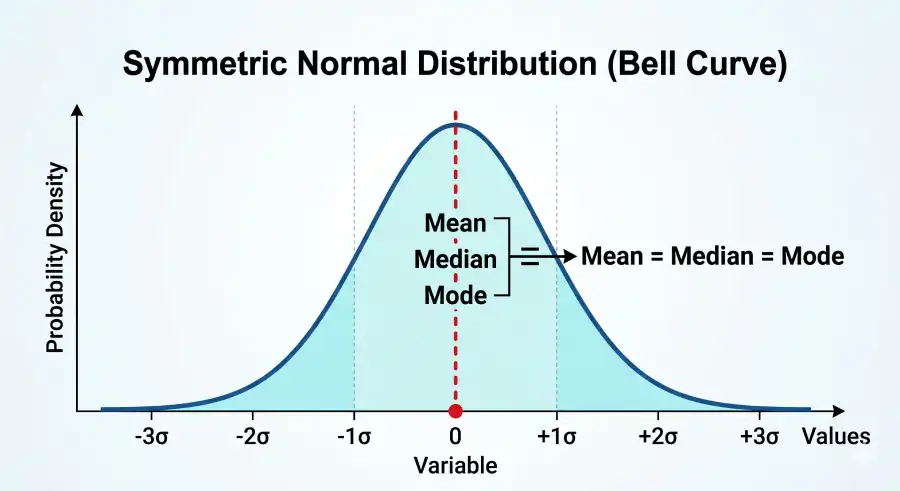
On any histogram or probability density curve, the mode corresponds to the peak — the tallest bar in a histogram, or the highest point on a continuous curve. This geometric interpretation connects the abstract definition ("most frequent value") to a visible shape.
Symmetric Distributions: Mean = Median = Mode
In a perfectly symmetric, unimodal distribution (the normal distribution), the mean, median, and mode all coincide at exactly the same value — the center of the curve. Symmetry ensures no value is systematically pulled left or right, so the most common value, the middle value, and the arithmetic average all land at the same point. This is formally covered in Wackerly, Mendenhall, and Scheaffer's Mathematical Statistics with Applications (8th ed., Cengage), the standard text at most university statistics programs.
Skewed Distributions: How Mode, Median, and Mean Separate
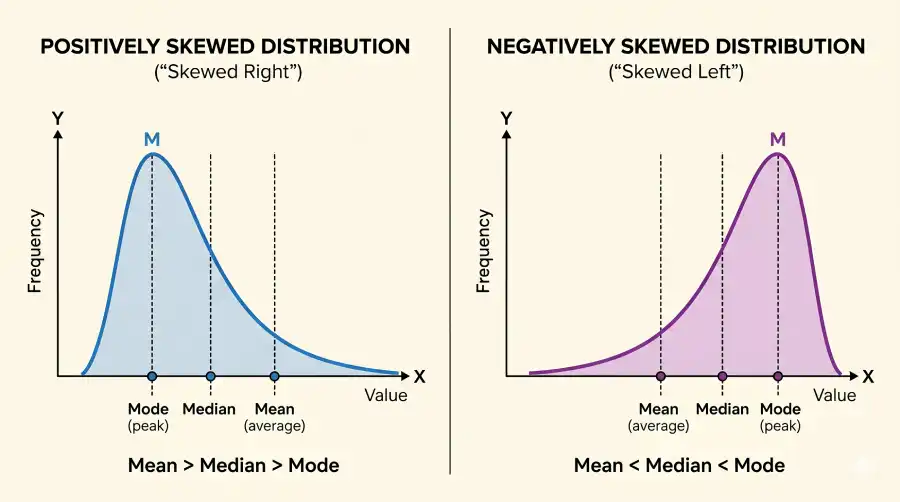
Skewness pulls the mean — and, to a lesser degree, the median — away from the mode. The mode always sits at the peak. The mean gets dragged toward the tail because it responds to every value arithmetically. The median lands between them. This ordering gives rise to Pearson's empirical rule.
Case Study — Income Data in the United States
Why median income is reported instead of mean income
The U.S. Census Bureau reports median household income rather than mean in its official tables (U.S. Census Bureau, Income and Poverty). The reason is positive skewness: a small number of extremely high earners pull the mean above the income of the typical household. The mode of the income distribution — the income bracket appearing most frequently — sits lower still. Reporting the mean alone would give a figure that exceeds the actual income of the majority of households, making the mode or median far more representative of "typical" income.
Pearson's Empirical Relationship: Mode, Mean & Median
Karl Pearson derived an approximate relationship between the three measures of central tendency that holds for moderately skewed, unimodal distributions. This formula lets you estimate any one of the three from the other two — useful when only summary statistics are available.
Rearranges to: Median ≈ (Mode + 2·Mean) / 3 | Mean ≈ (3·Median − Mode) / 2
A dataset has a mean of 60 and a median of 65. Use Pearson's formula to estimate the mode.
Apply the formula: Mode ≈ 3(65) − 2(60) = 195 − 120 = 75
Check the direction: Mode (75) > Median (65) > Mean (60). This ordering is consistent with a negatively skewed distribution, where the left tail drags the mean down below the mode. The result is internally consistent.
✓ Estimated Mode ≈ 75. Remember: this is an approximation. For exact results, you need the raw data or the full frequency distribution.
The rule breaks down for bimodal or multimodal distributions (it assumes a single peak), heavily skewed datasets, and discrete distributions with very few values. Wikipedia notes that even the median-lying-between-mean-and-mode rule "is not always true and in general the three statistics can appear in any order" outside of moderate skewness conditions. Do not apply it mechanically without first confirming a roughly unimodal, moderately skewed shape.
Ordering of Mean, Median & Mode by Distribution Shape
| Distribution Shape | Ordering | Example Context | Pearson Rule Applies? |
|---|---|---|---|
| Perfectly symmetric (normal) | Mean = Median = Mode | Heights in a large homogeneous population | Trivially — all three equal |
| Positively skewed (right tail) | Mode < Median < Mean | Income distributions, house prices | Yes, for moderate skew |
| Negatively skewed (left tail) | Mean < Median < Mode | Age at retirement; exam scores with a ceiling | Yes, for moderate skew |
| Bimodal | No fixed ordering | Adult heights (male + female combined) | No — assumes unimodal |
| Uniform | Mean = Median; No mode | Outcomes of a fair die roll | Not applicable (no mode) |
When to Use Mode vs Mean vs Median — Decision Guide
The mean is the default measure for most numerical data, but three specific situations make the mode the better — or the only — choice. The table below serves as a practical decision guide.
Mode vs Mean vs Median — Which to Use?
| Situation | Best Measure | Why |
|---|---|---|
| Categorical data (colors, names, votes) | Mode | Mean and median are undefined for non-numerical labels |
| Most common value in inventory/demand | Mode | Mean shoe size 9.3 tells you nothing; mode = most restocked size |
| Dataset with extreme outliers | Mode or Median | Mode is completely immune; median is resistant; mean is distorted |
| Survey ratings (1–5 scale) | Mode | Mean 3.4 doesn't correspond to a real rating; mode shows what people most chose |
| Symmetric, numerical data | Mean | Maximizes information when distribution is roughly normal |
| Further calculations (SD, t-tests) | Mean | Standard deviation, variance, and most inferential tests are built on the mean |
| Skewed numerical data (incomes, prices) | Median | Less sensitive to outliers than mean; better represents the "typical" value |
| Ranked or ordinal data | Median | Order exists but intervals may not be equal; mean assumes equal intervals |
Categorical / Nominal Data
Most popular shirt color? Most common voting choice? No numeric order exists, so mean and median are undefined. The mode is the only valid answer.
Inventory & Demand Planning
A store reorders based on the mode, not the mean. The modal shoe size tells you exactly what to put back on the shelf; the average size (9.3) tells you nothing actionable.
Discrete Data with Few Values
Survey ratings rarely have a meaningful mean. The mode — the most common rating selected — is more directly interpretable for decision-making.
Outlier-Contaminated Datasets
The mode of {2, 5, 5, 7, 10,000} is 5 regardless of the outlier. The mean is 2003.8, which misrepresents the bulk of the data entirely.
Healthcare: Most Common Diagnosis
In a clinic's monthly patient log, the modal diagnosis tells staff which condition to prepare for most often — a planning input neither mean nor median diagnosis codes can provide.
Voting and Elections
In a plurality election, the winner is the candidate chosen by the most voters — the modal choice. Mean and median are not defined for named candidates.
History of the Mode: Karl Pearson, 1895
The term "mode" in its statistical sense was coined by Karl Pearson in his 1895 paper "Contributions to the Mathematical Theory of Evolution. II. Skew Variation in Homogeneous Material," published in the Philosophical Transactions of the Royal Society of London. In a footnote, Pearson wrote: "I have found it convenient to use the term mode for the abscissa corresponding to the ordinate of maximum frequency." (Pearson, 1895, p. 345).
This same paper introduced the Pearson skewness coefficient and explored the relationship between mode, median, and mean in skewed distributions — giving us the empirical formula Mode ≈ 3(Median) − 2(Mean) that is still taught in introductory statistics courses today. The term derives from the French la mode ("the fashion"), capturing the intuition that the mode is the most fashionable — i.e., most common — value in the data.
Before Pearson's formalization, the concept existed informally. Astronomers had long used the "most probable value" (essentially the mode of a frequency distribution) for data reduction, and social scientists used the modal class informally. Pearson gave it a precise name and connected it analytically to the other measures of central tendency.
Mode Formula Glossary — All Notations Defined
The table below consolidates every term used in mode calculations so the formulas can be read without referring back to earlier sections — useful for quick reference during exam problems or grouped-data calculations.
| Symbol / Term | Notation | Meaning | Example |
|---|---|---|---|
| Mode symbol | Mo | Standard symbol for mode; no Greek letter equivalent | Mo = 85 |
| Mode (ungrouped) | Mo = max f(x) | The value that appears most often in raw data | Mo = 85 in {68, 72, 85, 85, 85, 90, 91} |
| Modal class | — | Class interval with the highest frequency in a grouped table | 4,000–5,000 (f = 22) |
| Lower class limit | l | The lowest value that belongs to the modal class | l = 4,000 |
| Modal class frequency | f₁ | Count of observations in the modal class | f₁ = 22 |
| Pre-modal frequency | f₀ | Frequency of the class immediately before the modal class | f₀ = 14 |
| Post-modal frequency | f₂ | Frequency of the class immediately after the modal class | f₂ = 10 |
| Class width | h | Range of each class interval (upper − lower limit) | h = 1,000 |
| Pearson's empirical estimate | Mo ≈ 3Md − 2x̄ | Approximates mode from median (Md) and mean (x̄) | 3(65) − 2(60) = 75 |
| Unimodal | |Mo| = 1 | Exactly one mode exists | {3, 5, 5, 5, 8} → Mo = 5 |
| Bimodal | |Mo| = 2 | Exactly two modes tied at the highest frequency | {10, 10, 25, 25} → Mo = 10, 25 |
| Multimodal | |Mo| ≥ 3 | Three or more modes | {2, 2, 4, 4, 6, 6} → Mo = 2, 4, 6 |
| No mode | Mo = ∅ | All values appear with equal frequency (usually once) | {1, 2, 3, 4, 5} |
Mode vs Mean vs Median: Full Comparison Table
The three measures of central tendency answer different questions about a dataset. None is universally superior — the right choice depends on data type, distribution shape, and intended use. See the full comparison guide: Mean vs Median vs Mode.
| Property | Mode (Mo) | Median (Md) | Mean (x̄ / μ) |
|---|---|---|---|
| Definition | Most frequent value | Middle value when sorted | Sum ÷ count |
| Works on categorical data? | ✅ Yes | ❌ No (needs order) | ❌ No (needs numbers) |
| Affected by outliers? | No — completely immune | Slightly — resistant but not immune | Yes — highly sensitive |
| Unique value guaranteed? | No — can have 0, 1, or many | Yes — always one value | Yes — always one value |
| Normal distribution | = Median = Mean | = Mode = Mean | = Mode = Median |
| Positively skewed | Lowest of three | Middle value | Highest of three |
| Negatively skewed | Highest of three | Middle value | Lowest of three |
| Best for | Categorical; most common; inventory | Skewed data; incomes; ranks | Symmetric data; further calculations |
| Used in further statistics? | Rarely (no algebra) | Percentile calculations | SD, variance, t-tests, regression |
| Symbol | Mo (or Z in some texts) | Md (or M) | x̄ (sample), μ (population) |
If you need to compute all three simultaneously, the mean, median, and mode calculator accepts any dataset and returns all three values plus the range. You can also visualize the positions of all three on a mean, median, and mode visualizer or build a frequency distribution with the frequency distribution table maker.
Mode of a Probability Distribution
For continuous probability distributions, the mode is defined as the value at which the probability density function (PDF) reaches its maximum. This is subtly different from the sample mode: for a finite dataset, the mode is an observed value that repeats most. For a continuous distribution, the mode is the theoretical peak of the PDF — often no single data point lands exactly on it.
Key distribution modes to know for exams:
- Normal distribution: Mode = Mean = Median (at the center of the bell curve). Covered in detail at Normal Distribution.
- Uniform distribution: No mode — all values have equal probability. A fair die roll has no mode over the long run.
- Binomial distribution: Mode ≈ floor((n+1)p) for parameters n and p. If (n+1)p is an integer, the distribution is bimodal. Covered at Binomial Distribution.
- Poisson distribution: Mode = floor(λ) for rate parameter λ. If λ is an integer, bimodal at λ−1 and λ.
- Skewed distributions (e.g., log-normal): Mode < Median < Mean for positive skew. The log-normal distribution is a classic example covered in financial and income data analysis.
The relationship between the mode of a probability distribution and z-scores is worth noting: for the standard normal distribution, the mode is at z = 0 (the center), and a z-score of 0 corresponds to the most probable observation. Deviations from the mode in standard deviation units are precisely what z-scores measure.
Frequently Asked Questions about Mode in Statistics
The mode in statistics is the value that appears most often in a dataset. For {1, 3, 3, 5, 7}, the mode is 3 because it appears twice while all other values appear once. The symbol for mode is Mo. A dataset can have one mode (unimodal), two modes (bimodal), many modes (multimodal), or no mode if every value appears the same number of times.
The standard symbol for mode in statistics is Mo (capital M, lowercase o). There is no dedicated Greek letter for the mode. In older British textbooks and some Indian university curricula, Z is used instead. The formula notation is: Mo = value x where f(x) is maximum. In software: Excel uses MODE() or MODE.MULT(); Python uses scipy.stats.mode(); R uses which.max(table(x)).
For ungrouped data: the mode formula is simply Mo = the most frequent value — no arithmetic formula is needed, just count. For grouped data: Mo = l + [(f₁ − f₀) / (2f₁ − f₀ − f₂)] × h, where l is the lower class limit of the modal class, f₁ is its frequency, f₀ and f₂ are the frequencies of the preceding and succeeding classes, and h is the class width. Pearson's empirical approximation: Mo ≈ 3(Median) − 2(Mean).
There are four types of mode in statistics: (1) Unimodal — one mode exists, e.g. {2, 3, 3, 4} → Mode = 3. (2) Bimodal — two values tie for highest frequency, e.g. {1, 1, 2, 3, 3} → Mode = 1 and 3. (3) Multimodal — three or more values share the highest frequency, e.g. {2, 2, 4, 4, 6, 6} → Mode = 2, 4, 6. (4) No Mode — every value appears equally often, e.g. {1, 2, 3, 4} → no mode.
In math class, mode means the number in a list that appears most often. For the list {4, 7, 7, 8, 9}, the mode is 7 because it appears twice, while all other numbers appear once. To find the mode: (1) list all numbers, (2) count how many times each appears, (3) the one that appears most is the mode. If two numbers tie, there are two modes. If all appear equally, there is no mode.
Yes — the mode is the only measure of central tendency that applies to nominal (categorical) data. If a survey of 100 people about their favorite color returns 40 for red, 35 for blue, and 25 for yellow, the mode is red. There is no way to compute a "mean color" or "median color," but the mode is well-defined and meaningful. This is why the mode is used for polling, vote counting, and market research on preferences. See UCLA OARC's statistical methods guide for the full measurement scale breakdown.
Bimodal means exactly two modes — two values share the highest frequency, giving a histogram with two peaks. Multimodal is the broader term for any distribution with two or more modes — so bimodal is a specific type of multimodal. A dataset with three tied-highest frequencies is trimodal (a type of multimodal but not bimodal). Bimodal distributions in real data often signal two distinct subpopulations (e.g., heights of adults mixing male and female), while higher multimodal patterns suggest more complex structure.
The mode is completely unaffected by outliers. Consider {3, 5, 5, 7}: mode = 5, mean = 5. Add the outlier 10,000 to get {3, 5, 5, 7, 10,000}: the mode is still 5, but the mean jumps to 2,004. This immunity is one reason the mode is preferred in quality control and any context where catastrophic outliers should not define the "typical" observation. The outlier detection guide explains how to identify and handle outliers before choosing a measure of central tendency.
Sources and Further Reading
Academic and Institutional References
NIST/SEMATECH e-Handbook of Statistical Methods. "Measures of Location: Mode." National Institute of Standards and Technology. itl.nist.gov
Penn State STAT 100: Statistical Concepts and Reasoning. Lesson 2.2: "Describing Data: Measures of Center." online.stat.psu.edu
Pearson, Karl (1895). "Contributions to the Mathematical Theory of Evolution. II. Skew Variation in Homogeneous Material." Philosophical Transactions of the Royal Society of London A, 186, 343–414. doi:10.1098/rsta.1895.0010. [Original paper coining "mode" in statistics]
Sheffield, S. (2022). MIT 18.600: Probability and Random Variables, Lecture 3 Notes. Massachusetts Institute of Technology. math.mit.edu
U.S. Census Bureau. Income and Poverty Statistics Documentation. census.gov
UCLA Statistical Consulting Group (OARC). "What Statistical Analysis Should I Use?" stats.oarc.ucla.edu
Wackerly, D., Mendenhall, W., & Scheaffer, R.L. (2008). Mathematical Statistics with Applications, 7th ed. Thomson Brooks/Cole. [Covers Pearson's empirical relationship, Chapters 1–2]
Kenney, J. F. and Keeping, E. S. (1962). "The Mode." §4.7–4.9 in Mathematics of Statistics, Pt. 1, 3rd ed. Van Nostrand. [Classic reference cited by MathWorld for the empirical mean-mode relationship]
Related Topics on Statistics Fundamentals
The mode is one piece of a broader toolkit in descriptive statistics. To master central tendency fully, explore the guides below alongside this one.
Mean (Average)
Arithmetic, geometric, and weighted means with full formulas and step-by-step examples.
Median
The middle value for sorted data — resistant to outliers and the standard for skewed distributions.
Standard Deviation
The primary measure of spread — how far individual values sit from the mean on average.
Variance
The squared average of deviations from the mean — the building block of standard deviation.
Types of Data
Nominal, ordinal, interval, and ratio scales — and which statistical operations apply to each.
Normal Distribution
The bell curve where mean = median = mode — and how the 68-95-99.7 rule applies.
Outliers
How to detect and handle extreme values — and why they push the mean away from the mode.
Percentiles
Dividing a distribution into 100 equal parts — and how percentiles relate to the median (P50).
Additional tools and related content from Statistics Fundamentals:
- Mean, Median & Mode Visualizer — see all three measures on a histogram simultaneously
- Frequency Distribution Table Maker — build the frequency tables used to find the mode
- Histogram Maker — visualize mode as the peak bar in your own data
- Discrete vs Continuous Data — understand when the mode is exact vs estimated
- Exploratory Data Analysis (EDA) — where mode fits in the full EDA workflow
- Five-Number Summary — the full picture of a distribution alongside mode
- Inferential Statistics — moving from descriptive summaries like mode to population inferences
- Descriptive Statistics Calculator — compute mode, mean, median, SD, and more together