
Fixed calendar dates, not a repeating weekday
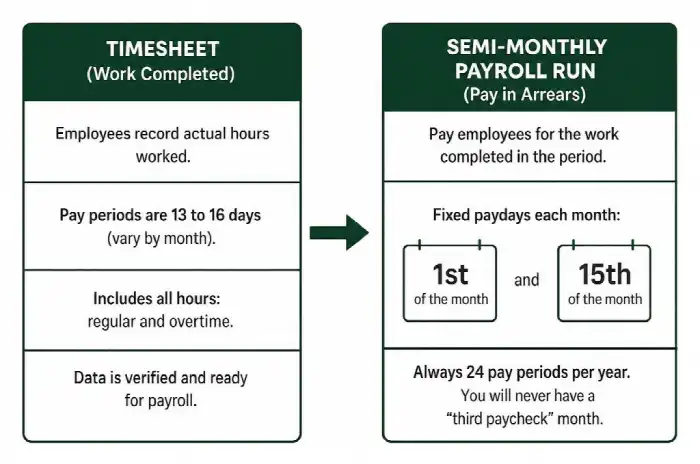
A semi-monthly schedule is built around the calendar, not the week. You pay your staff on two specific days each month, such as the 1st and the 15th. This means your pay periods do not always start or end on the same day of the week.
Because months have different numbers of days, your pay periods will range from 13 to 16 days long. You are paying in arrears, which means you are paying employees for the work they completed during that specific window of time. Since the number of workdays in each period changes, your internal payroll team must be ready to track time and process data within these shifting windows.
How it differs from every-two-weeks pay
It is common to confuse semi-monthly with biweekly pay, but they are very different. Biweekly pay occurs every 14 days, usually on a specific day like every other Friday. This results in 26 pay periods per year, and occasionally 27.
A semi-monthly schedule is always 24 pay periods. You will never have a "third paycheck" month, which makes annual budgeting much easier to predict.
| Schedule | Pay Periods per Year | Payday Pattern | Best Fit |
|---|---|---|---|
| Weekly | 52 | Same day every week | Hourly-heavy industries |
| Biweekly | 26 (or 27) | Same day every 2 weeks | Overtime-driven teams |
| Semi-monthly | 24 | Fixed calendar dates | Salaried, monthly budgets |
| Monthly | 12 | Once per month | Executive or small teams |
How common it is in practice
Semi-monthly payroll is a standard choice for many businesses. As of February 2023, about 19.8% of U.S. private establishments used this schedule. While biweekly remains the most common at 43%, and weekly sits at 27%, semi-monthly is a major player in specific sectors.
Industry trends are clear: the information industry leads the way, with 37.5% of establishments choosing semi-monthly pay. In contrast, the construction industry prefers weekly pay, with only 6.5% using semi-monthly schedules. Size also matters; smaller businesses with 1 to 9 employees use this schedule 22.5% of the time, while very large firms with over 1,000 employees drop to 5.6%.
How Pay Is Calculated for Different Workers
Salaried employees
Calculating pay for salaried workers is straightforward. You take the annual salary and divide it by 24. For example, if an employee earns $72,000 per year, their gross pay per check is $3,000. If they earn $60,000, they receive $2,500 per period. If you prefer to look at it by month, simply divide the monthly salary by two.
Hourly and nonexempt employees
Hourly pay requires more attention. You must pay employees for the actual hours they worked in that specific 13-to-16-day period. Do not use 86.67 hours as a default for every check. That number is just an annual average (2,080 hours divided by 24 periods) and will rarely match the actual hours worked in a specific pay period. Always rely on verified timesheets to ensure accuracy.
Overtime when workweeks split across pay periods
Federal law requires you to calculate overtime based on a fixed 168-hour workweek. This workweek does not change just because a pay period ends. If a workweek starts in one pay period and ends in the next, you must still track the hours correctly.
You cannot average hours over the 80-hour pay period. If an employee works 45 hours in the first week and 35 hours in the second week, they are owed 5 hours of overtime pay, even though their total hours for the pay period are 80.
Advantages and Drawbacks to Weigh
Benefits for employers
The biggest advantage is consistency. Because you run payroll exactly 24 times a year, your monthly cash flow is much easier to forecast. This aligns perfectly with monthly accounting cycles and financial reporting. You don't have to worry about the "three-paycheck month" that complicates budgeting in biweekly systems.
Benefits and challenges for employees
Employees often appreciate the steady rhythm. Getting paid on the same dates every month makes it easier to align paychecks with rent, mortgage, and utility bills, which are also typically due on a monthly basis. However, the wait between paychecks can feel longer than a weekly schedule, and the varying length of pay periods can make it harder for some workers to budget their daily spending.
Administrative trade-offs
The main downside is complexity. If you have a large hourly workforce, tracking overtime and varying hours across 24 periods can be more difficult than a 26-period biweekly cycle. You will need to reconfigure your payroll software to handle these dates, and your team will need to stay sharp to ensure that deductions and accruals remain accurate throughout the year.

Handling Weekends, Holidays and the 2026-2027 Calendar
When a payday lands on a non-business day
Since semi-monthly pay dates are fixed to the calendar, they will eventually fall on a weekend or a bank holiday. You should have a written policy that states whether you pay on the preceding business day or the following business day. Most employers choose the preceding business day—usually a Friday or Thursday—to ensure employees have their money before the weekend. Always check your state laws to ensure your chosen policy is compliant.
2026 and 2027 pay dates and exceptions
There are 24 pay periods in both 2026 and 2027. However, watch out for the January 1 payday. If you choose to pay that check on December 31 of the prior year, you effectively move that payment into the previous tax year. This can result in 23 paychecks in the new year. Additionally, bank holidays and Federal Reserve closures will affect when direct deposits settle. Always plan your bank transfer dates to account for these closures.
Cutoffs and processing deadlines
The payday is not your deadline. You must work backward from the payday to set your internal cutoffs. This includes time for timesheet submission, manager approval, overtime review, and the bank’s ACH processing window. During months with holidays, you may need to move your internal deadlines earlier to ensure employees are paid on time.
Taxes, Benefits and Compliance Checks
Tax withholding
Your annual tax liability does not change based on your pay frequency. Taxes are based on total annual income. Payroll software will automatically adjust the withholding for each of the 24 paychecks to ensure the correct amount is collected by the end of the year.
Health insurance and other deductions
Benefit deductions, such as health insurance premiums, should be split evenly across your two monthly paychecks. If an employee pays $200 a month for coverage, you deduct $100 from the check on the 1st and $100 from the check on the 15th. This keeps the employee’s take-home pay consistent.
State and federal payday rules
There is no federal law governing how often you must pay employees. However, many states have strict rules. Some states require weekly or biweekly pay for manual workers or hourly employees. These rules follow the employee, not your headquarters. If you have remote workers in different states, you must comply with the laws of the state where they perform their work.
Getting Professional Support for the Switch
Reviewing your current setup
Before you change your schedule, audit your current payroll handbook and deduction schedules. You must provide employees with advance notice if state law requires it. Ensure that you have a plan to pay any wages earned under the old schedule before you start the new one to avoid gaps in pay.
Choosing the Right Accounting Support
Setting up a new payroll schedule involves more than just changing dates in a software program. You must ensure that your tax withholdings, benefit deductions, and overtime calculations remain compliant with both state and federal regulations. If you are unsure about the technical requirements, you can find vetted accounting firms that specialize in payroll administration. These professionals can help you audit your current processes and ensure that your transition to a semi-monthly schedule is accurate and legally sound.
Implementing and communicating the change
Communication is key to a successful transition. Provide your employees with a clear calendar showing the new pay dates well in advance. Update your payroll software settings and double-check your deduction schedules to reflect the 24-period year.
- Audit current pay frequency rules in all states where you have staff.
- Update the employee handbook to reflect the new pay dates.
- Configure payroll software for 24 periods per year.
- Set internal deadlines for timesheet approvals and ACH processing.
- Notify employees of the change in writing.
Final Thoughts
A semi-monthly payroll works best for businesses with mostly salaried teams that want to align with monthly accounting cycles. If your company relies heavily on hourly workers and frequent overtime, a biweekly schedule might be easier to manage.
The best choice depends on your workforce, your state’s legal requirements, and your administrative capacity. Before you make the switch, map out your calendar, establish firm internal cutoffs, and consider consulting with an expert to ensure your new system is ready for your first pay run.