Sharper Visibility Into Where Money Actually Goes
Businesses that bring in Outsourced Accounting Services frequently discover they can guard current income whilst unlocking new growth potential. Most margin erosion happens in plain sight yet stays hard to quantify without steady, expert tracking. Regular financial evaluations uncover patterns that casual bookkeeping regularly misses, from recurring overspending to underpriced services. Leaders gain the self-assurance to regulate pricing, cut low-go-back sports, and defend the income that already exists inside the commercial enterprise.
Tracking Real Costs in Real Time
Consistent categorization and timely updates display the real cost of handing over each product or service, making it simpler to spot wherein fees quietly exceed plans.

Spotting Margin Leaks Before They Widen
Early flags on growing dealer costs, beyond regular time patterns, or gradually paying customers provide teams time to act while the effect continues to be small.
Turning Raw Data Into Decision-Ready Insights
Clean reviews arrive in formats leaders can really use, so financial conversations pass from "what passed off" to "what have to we do subsequently."
Stronger Control Over Cash and Working Capital
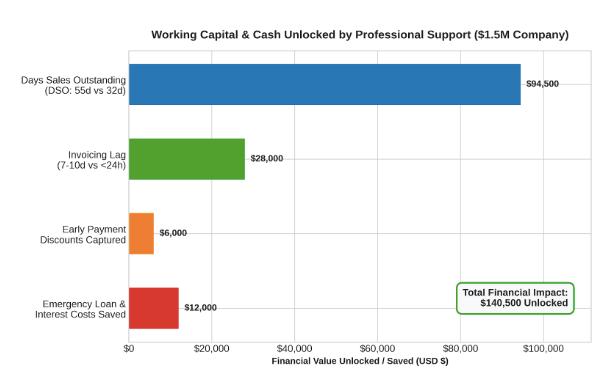
When the everyday books are handled via professional Outsourced Accountants, internal teams regain the bandwidth to focus on clients, product, and growth in place of chasing receipts and reconciling bills. Cash flow troubles kill larger groups than loss of income. Professional help keeps the rhythm of cash moving inside and outside the business. Invoices exit faster, collections live regular, and forecasts end up reliable enough to guide hiring, inventory, and expansion decisions. The result is fewer emergency loans and more strategic use of available capital.
| Cash Flow Driver | In-House / Casual Management | Professional Support Standard | Working Capital Unlocked ($1.5M Co.) |
|---|---|---|---|
| Days Sales Outstanding (DSO) | 55 Days | 32 Days | ~$94,500 Cash Unlocked |
| Invoicing Lag | 7–10 Days after work done | < 24 Hours | ~$28,000 Cash Unlocked |
| Early Payment Discounts Lost | $6,000 missed per year | 100% captured | +$6,000 Direct Savings |
| Emergency Credit/Loan Costs | $12,000 in interest/fees | $0 (Predictable Cash Buffer) | +$12,000 Saved |
Faster, Cleaner Invoicing Cycles
Systematic strategies lessen the lag between paintings finished and charges requested, shortening the cash conversion cycle.
Reliable Short-Term Forecasting
Accurate projections of incoming and outgoing funds assist leaders in avoiding cash crunches and idle balances that might be working harder.
Better Management of Payables and Receivables
Disciplined follow-up and charge timing shield relationships with providers while also ensuring the business isn't always financing its clients longer than necessary.
Capacity to Focus on Revenue-Generating Work
When financial management does not consume internal attention, teams can redirect strength towards activities that truly grow the top line. Sales, product improvement, and client revel in obtain the focus they deserve as opposed to competing month to month. The shift frequently produces measurable revenue profits, certainly because the right people are eventually free to do the proper work.

Freeing Leadership From Transactional Tasks
Owners and managers stop spending evenings on bookkeeping and begin spending that time on method, partnerships, and client relationships.
Supporting Smarter Pricing and Packaging Decisions
Accurate price statistics make it feasible to refine offers, take a look at new rate points, and drop unprofitable work without guesswork.
Creating Bandwidth for Growth Initiatives
With recurring finance handled, the organisation can pursue new markets, product lines, or operational improvements that have been formerly deferred.
Building Financial Habits That Scale With the Business
As businesses develop, casual structures that once felt "good enough" begin to break under the load of higher transaction volume, extra personnel, and more complexity. Establishing expert practices early creates a strong basis that scales easily rather than collapsing into chaos. Consistent techniques, clean ownership, and predictable assessment cycles save you the scramble that so often arrives with speedy growth and keep financial control calm while the commercial enterprise turns into greater disturbance.
- Standardized approaches preserve consistent reporting whilst transaction volume rises.
- Clear ownership of financial responsibilities reduces bottlenecks and last-minute scrambles.
- Regular assessment cycles turn financial management into a consistent rhythm instead of a periodic crisis.
Aligning Everyday Numbers With Long-Term Ambition
The handiest financial guide does more than maintain; it keeps the commercial enterprise pointed toward its large dreams. When budgets, forecasts, and overall performance metrics are deliberately connected to strategy, every month-to-month close turns into a checkpoint rather than a rearview exercise. Leaders stop treating the numbers as a rear-view mirror and begin the use of them as a forward-looking guide that suggests whether or not current performance is, without a doubt transferring the enterprise toward its supposed destiny.
- Budgets and forecasts stay connected to strategic priorities rather than floating as separate sporting activities.
- Performance metrics highlight the areas that honestly pressure margin and sales.
- Leaders get hold of early indicators when outcomes start to flow, allowing course corrections even as options remain open.
Final Thoughts
Protecting margins and increasing revenue rarely come from a unmarried dramatic move. They come from consistent visibility, disciplined cash management, and the liberty to recognition on increase as opposed to administration. When expert financial help handles the details with precision, management can concentrate on the choices that truly increase the commercial enterprise. The corporations that treat their numbers as a strategic asset rather than a compliance chore consistently preserve more of what they earn and create extra of what they want next.
FAQs
1. How quickly can an outsourced economic guide begin enhancing margin visibility?
Most agencies note clearer reporting and fewer surprises within the first one to 2 month-to-month cycles once regular techniques are in place.
2. Is this technique most useful for large organizations?
No. Smaller and mid-sized companies regularly gain quicker because they usually have fewer internal resources committed to certain economic control.
3. What is the largest distinction between simple bookkeeping and true financial aid?
Basic bookkeeping tracks what has already taken place. A strong leader turns those facts into well-timed insights that inform pricing, spending, and growth decisions.
4. Can better financial processes without a doubt assist in increasing revenue, not just shielding income?
Yes. When groups spend much less time on administrative firefighting, they gain capacity for income, product development, and client projects that, without delay, increase sales.
5. How do corporations manage while financing actions outside the enterprise?
Clear reporting schedules, shared dashboards, and regular evaluation meetings keep leadership completely knowledgeable and in control of every primary decision.