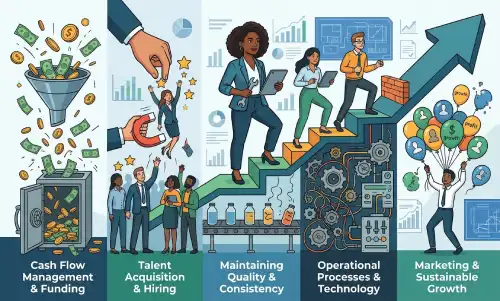
Scaling involves much more than increasing sales or hiring additional employees. It requires financial discipline, effective leadership, operational planning, and the ability to adapt existing processes to changing demands. Businesses that expand without addressing these areas often experience communication problems, declining customer satisfaction, and operational bottlenecks that prevent them from achieving their growth potential.
Although the challenges vary across industries, many businesses encounter similar obstacles during expansion. Some struggle to maintain healthy cash flow, while others find it difficult to recruit qualified employees, preserve customer relationships, or manage increasing operational complexity. Understanding these difficulties allows business owners to make informed decisions and create a stronger foundation for sustainable growth.
Overview of scaling challenges
| Challenge | Core Issue | Key Solution |
|---|---|---|
| Managing Cash Flow | Expenses rising faster than available cash | Realistic forecasts and emergency reserves |
| Operational Systems | Informal processes break under growth | Standardized procedures and automation |
| Hiring and Retention | Recruiting too fast or too slow | Structured onboarding and career development |
| Service Quality | Consistency declines at scale | Clear standards and regular feedback |
| Customer Acquisition | Early channels stop scaling profitably | Diversified and measurable marketing strategy |
| Brand Reputation | Customer experience becomes inconsistent | Uniform communication standards across teams |
| Supply Chain | Dependence on individual partners | Alternative suppliers and clear contracts |
| Technology | Tools create complexity rather than clarity | Operationally relevant and integrated platforms |
| Profitability | Revenue grows but margins shrink | Monitor gross and net profit margins closely |
| Leadership | Founder bottleneck slows decisions | Delegate with clear accountability structures |
| Company Culture | Values dilute with rapid hiring | Define and communicate organizational values |
| Expansion Timing | Mistaking short-term demand for readiness | Test new markets at smaller scale first |
1. Managing Cash Flow During Business Expansion
Maintaining healthy cash flow is one of the biggest challenges business owners face when scaling their operations. Expansion typically requires additional investment in employees, equipment, technology, marketing, and inventory. However, the financial benefits of these investments may take considerably longer to materialize.
A company experiencing strong sales growth can still face financial difficulties if its expenses increase faster than available cash. For example, a business may need to hire additional employees before securing enough customers to cover their salaries. Similarly, retailers entering new markets may need to purchase larger quantities of inventory without knowing exactly when those products will sell.
Several financial challenges become particularly important during expansion:
- Increasing operational expenses: Larger teams, additional office space, and upgraded technology can significantly increase monthly costs.
- Delayed customer payments: Businesses offering credit terms may experience cash shortages even when sales figures remain strong.
- Unexpected expansion costs: Equipment repairs, recruitment delays, and changes in supplier pricing can create additional financial pressure.
- Insufficient cash reserves: Companies without adequate financial buffers may struggle to manage temporary revenue fluctuations.
Business owners can reduce these risks by developing realistic financial forecasts and monitoring cash flow regularly. Establishing clear budgets, reviewing payment cycles, and maintaining emergency reserves can help businesses expand without compromising financial stability.
For a deeper understanding of how financial data supports business decisions, see our guide on business statistics, which covers the key metrics used to evaluate business performance.
2. Building Operational Systems That Can Handle Growth
Small businesses frequently depend on informal processes that work effectively when teams are relatively small. Employees may communicate directly with the owner, customer information might be managed through spreadsheets, and important decisions may depend on individual experience rather than established procedures.
As the organization grows, these approaches can become increasingly difficult to maintain. More customers generate additional requests, larger teams require better coordination, and complex workflows increase the possibility of errors. Without standardized operating procedures, employees may interpret responsibilities differently, leading to inconsistent results and unnecessary operational costs.
"One of the biggest mistakes businesses make when expanding is assuming that adding more people will automatically solve operational problems. If responsibilities are unclear and communication is inconsistent, a larger team can create even more confusion. You need reliable processes before increasing your capacity."
— Sharon Amos, Director at Air Ambulance 1To establish scalable operations, business owners should prioritize several improvements:
- Document important procedures so employees can perform tasks consistently.
- Establish clear responsibilities and reporting structures across departments.
- Introduce systems that monitor operational performance and identify bottlenecks.
- Automate repetitive administrative activities where practical.
- Regularly evaluate workflows to eliminate unnecessary steps and delays.
Creating reliable processes allows businesses to serve more customers without placing excessive pressure on employees. It also reduces dependence on individual team members and makes operations more predictable.
3. Hiring and Retaining the Right Employees
Recruitment becomes increasingly important as businesses move beyond their initial growth stages. In smaller organizations, founders often handle multiple responsibilities, including marketing, customer service, financial planning, and employee supervision. Although this approach may work initially, it becomes increasingly difficult as operational demands expand.
Hiring additional employees appears to be an obvious solution, but recruitment introduces its own challenges. Business owners must identify qualified candidates, evaluate their experience, provide adequate training, and ensure new employees understand the company's expectations. Hiring too quickly can increase expenses and create management difficulties, while delaying recruitment may place excessive pressure on existing employees.
Businesses should focus on three important areas when expanding their workforce:
- Skills and experience: Recruit employees whose capabilities align with the organization's current needs and future objectives.
- Training and development: Provide structured onboarding and continuous learning opportunities to maintain consistent performance.
- Employee retention: Offer clear career development opportunities, constructive feedback, and a supportive working environment.
Retaining experienced employees is particularly valuable because frequent turnover can affect productivity, customer relationships, and organizational knowledge. Companies that invest in their workforce are generally better positioned to build stable teams capable of supporting continued expansion.
Data-driven approaches to hiring and retention are covered in our article on people analytics, which explores how organizations use workforce data to make better employment decisions.
4. Maintaining Service Quality While Serving More Customers
One of the most difficult aspects of business expansion is maintaining the same level of service as customer demand increases. A smaller business can often provide personalized attention, respond quickly to inquiries, and maintain close relationships with individual customers. As operations expand, delivering that experience consistently becomes more challenging.
This issue is especially important for service-based businesses, where communication, reliability, and customer satisfaction directly influence reputation. Expanding appointment schedules, increasing customer volume, or adding service locations can stretch resources and create opportunities for mistakes.
"When a service-based business grows, maintaining consistency becomes one of the hardest responsibilities for its leadership. Customers should receive the same attention and professionalism regardless of how busy the organization becomes. Growth should never mean that people feel they are receiving a less personal service."
— Ayham Al-Ayoubi, Founder and Medical Director of London Medical & Aesthetic ClinicBusiness owners can maintain service quality during expansion by focusing on several key practices:
- Establish clear service standards that employees can follow across departments.
- Collect customer feedback regularly to identify areas requiring improvement.
- Invest in employee training to maintain professionalism and consistency.
- Monitor response times, customer complaints, and repeat business.
- Ensure staffing levels remain appropriate for increasing customer demand.
Maintaining quality requires continuous attention rather than occasional improvements. Businesses that measure customer satisfaction alongside revenue growth are better equipped to identify operational problems before they damage long-term relationships.
5. Creating a Predictable Customer Acquisition Strategy
Attracting new customers becomes increasingly complicated as businesses expand beyond their original markets. Early growth may come from personal referrals, local relationships, or limited marketing investments. However, these sources may not generate enough demand to support larger operations.
Businesses entering competitive markets must develop customer acquisition strategies that produce consistent results without creating excessive expenses. Marketing channels that perform well at a smaller scale may become less profitable when advertising costs increase or competition intensifies.
A predictable marketing strategy requires businesses to monitor several important performance indicators:
- Customer acquisition cost: The average amount spent to acquire each new customer.
- Conversion rate: The percentage of potential customers who complete a desired action.
- Customer lifetime value: The estimated revenue a customer generates throughout their relationship with the business.
- Marketing return on investment: The financial return associated with marketing expenditure.
Business owners should also diversify their marketing efforts through search engine optimization, content marketing, targeted advertising, and referral programs. Developing a balanced strategy reduces dependence on individual channels and creates more opportunities for sustainable customer growth.
Statistical forecasting tools can help businesses anticipate demand shifts. Our guide on how statistical forecasting helps businesses prepare for seasonal changes explains the methods most relevant to growing operations.
6. Protecting Brand Reputation as the Business Expands
A strong reputation often contributes significantly to a company's early success. Customers may initially choose a business because of its personalized service, product expertise, responsiveness, or direct relationship with the owner. However, maintaining these qualities becomes more difficult when customer interactions are distributed across larger teams, additional locations, and multiple sales channels.
As businesses scale, individual customer experiences become increasingly important. Negative reviews, delayed responses, inconsistent product information, or poorly handled complaints can influence how potential customers perceive the entire organization.
Business owners can protect their reputation during expansion by:
- Maintaining consistent communication and customer service standards.
- Responding professionally to customer feedback and complaints.
- Training employees to understand the company's values and brand positioning.
- Ensuring marketing promises accurately reflect the customer experience.
- Monitoring online reviews and addressing recurring service concerns.
Protecting brand reputation requires ongoing effort from every department. Companies that maintain consistency across customer interactions are more likely to preserve the trust and credibility that contributed to their initial success.
7. Managing Supply Chains and External Business Partners
Business expansion often increases dependence on suppliers, contractors, service providers, and other external partners. A retailer may require additional inventory sources, a service company might outsource administrative functions, and a growing organization may need specialized technology providers to support its operations.
Although these partnerships can improve efficiency, they also introduce risks. Supplier delays, inconsistent product quality, unexpected price increases, and communication failures can disrupt operations. As customer demand increases, even relatively minor problems with external partners can have a greater impact on overall performance.
To reduce these risks, business owners should establish clear expectations with suppliers and regularly review their performance. Important considerations include:
- Evaluating suppliers based on reliability, product quality, and delivery performance.
- Maintaining alternative suppliers where practical to reduce operational dependence.
- Establishing clear contracts covering pricing, service standards, and responsibilities.
- Monitoring inventory levels and anticipated customer demand.
Strong supplier relationships can support expansion, but businesses must avoid becoming overly dependent on individual partners. Developing contingency plans and maintaining consistent communication can help organizations manage unexpected disruptions.
8. Choosing the Right Technology Without Creating More Complexity
Technology can help businesses scale by automating repetitive activities, improving communication, and providing greater visibility into daily operations. Customer relationship management systems, accounting software, project management platforms, and inventory tools can reduce administrative workloads and improve organizational efficiency.
However, implementing technology does not automatically improve business performance. Companies sometimes invest in expensive platforms without fully understanding their operational requirements or ensuring employees can use them effectively. Introducing multiple disconnected systems may create duplicate records, inconsistent information, and additional administrative work.
Business owners should consider three factors before investing in new technology:
- Operational relevance: Does the software address a specific problem or improve an existing process?
- Ease of integration: Can the platform connect with current systems without creating unnecessary complexity?
- Long-term scalability: Will the solution remain useful as the company expands its workforce, services, or customer base?
Employee training and data security should also influence technology decisions. Rather than adopting every new platform available, organizations should prioritize tools that deliver measurable efficiency improvements and support long-term business objectives.
For business owners exploring how artificial intelligence fits into their technology stack, our article on AI for business statistics examines the practical applications and measurable outcomes of AI adoption in growing companies.
9. Maintaining Profitability as Operating Costs Increase
Higher revenue does not necessarily translate into stronger profitability. As companies expand, they often experience additional expenses that were less significant during their early stages. These may include larger premises, management salaries, insurance, software subscriptions, professional services, and increased administrative responsibilities.
Expansion can also introduce hidden expenses. Additional employees require training and supervision, larger customer bases generate more support requests, and entering unfamiliar markets may involve unexpected marketing or operational costs.
Business owners should regularly review the following financial indicators:
- Gross profit margin: Measures how much revenue remains after direct costs.
- Operating expenses: Includes the ongoing costs required to manage business activities.
- Net profit margin: Indicates the percentage of revenue remaining after expenses.
- Revenue per employee: Helps evaluate workforce productivity as operations expand.
Monitoring these indicators allows businesses to identify declining profitability before it becomes a serious problem. Understanding which products, services, and customer segments generate the strongest returns also helps management allocate resources more effectively.
Sustainable scaling should improve a company's ability to generate profit rather than simply increasing its overall size.
Our article on how expert financial support helps businesses protect margins and increase revenue explores the practical ways financial guidance can address the profitability challenges that emerge during expansion.
10. Developing Leadership and Delegating Responsibilities
Many entrepreneurs build successful businesses through direct involvement in nearly every operational decision. Their personal relationships, industry knowledge, and attention to detail often contribute significantly to early growth. However, this hands-on management style can become a major obstacle as the organization expands.
When too many responsibilities remain concentrated at the leadership level, operational delays become more frequent. Employees may hesitate to make decisions independently, while business owners become overwhelmed by daily management duties instead of focusing on strategic planning.
Effective delegation requires clear responsibilities, employee training, and appropriate decision-making authority. Business owners can improve leadership structures by:
- Assigning department managers responsibility for routine operational decisions.
- Establishing measurable performance expectations and accountability systems.
- Providing leadership development opportunities for experienced employees.
- Scheduling regular management reviews to discuss challenges and progress.
Developing capable managers allows organizations to operate more independently while maintaining appropriate oversight. It also creates opportunities for business owners to concentrate on long-term planning, market expansion, and organizational development.
Our article on whether a leadership training program is worth it examines the evidence behind investment in management development for growing businesses.
11. Preserving Company Culture During Rapid Expansion
Company culture can change considerably as an organization grows. In smaller businesses, employees often communicate directly with leadership and develop close working relationships. Shared expectations may emerge naturally through daily interactions, making formal policies less necessary.
As companies recruit more employees and establish additional departments, maintaining these informal connections becomes increasingly difficult. New team members may have different communication preferences, working habits, and professional expectations. Without clearly defined organizational values, businesses may develop inconsistent management practices that affect collaboration and employee engagement.
Maintaining a healthy workplace culture requires consistent communication and leadership involvement. Business owners should clearly define the organization's values, encourage constructive employee feedback, and ensure managers demonstrate the behaviors expected from their teams.
Organizations should also provide opportunities for professional development and recognize employees who contribute positively to business objectives. When workers understand the company's direction and feel supported in their responsibilities, they are generally better equipped to adapt to operational changes.
12. Balancing Expansion Opportunities With Operational Stability
Determining when to pursue new growth opportunities is another significant challenge for business owners. Expanding into additional markets, launching new services, or opening more locations can create opportunities for increased revenue. However, pursuing too many initiatives simultaneously can stretch financial and operational resources.
Businesses sometimes mistake temporary increases in demand for evidence that they are ready for significant expansion. A short period of strong sales does not necessarily justify permanent increases in staffing, infrastructure, or operating expenses.
Before committing to additional growth initiatives, business owners should consider several important questions:
- Can existing operations support additional demand without compromising service quality?
- Does the business have sufficient financial resources to cover expansion costs?
- Are current employees and managers prepared to handle additional responsibilities?
- Is there reliable evidence of long-term demand in the proposed market?
- What potential risks could affect existing customers and operations?
Answering these questions allows business owners to evaluate expansion opportunities more objectively. Testing new services or markets on a smaller scale can also provide valuable insights while limiting financial exposure.
Gradual expansion gives organizations time to strengthen internal processes and address operational weaknesses before they affect a larger business.
13. Building a Practical Strategy for Sustainable Growth
Overcoming the challenges of scaling requires a structured strategy that connects financial planning, operational efficiency, customer experience, and leadership development. Rather than treating growth as a continuous race to increase revenue, business owners should establish measurable objectives and identify the resources required to achieve them.
The first step involves evaluating current operations. Management should identify processes that regularly create delays, activities that depend heavily on individual employees, and expenses that increase disproportionately with demand.
A practical business scaling strategy should include the following steps:
- Establish clear growth objectives. Define realistic financial, operational, and customer acquisition targets. These objectives should align with the company's available resources and long-term business priorities.
- Strengthen existing business processes. Review current workflows and identify opportunities to improve efficiency. Standardized procedures can help employees maintain consistent performance as operational demands increase.
- Invest in employees and leadership development. Recruit qualified professionals, provide appropriate training, and develop managers capable of handling additional responsibilities.
- Monitor financial and operational performance. Use financial reports, customer satisfaction data, and operational performance indicators to evaluate whether expansion is producing the intended results.
- Maintain flexibility in business planning. Market conditions, customer expectations, and operational requirements can change unexpectedly. Businesses should regularly review their strategies and make adjustments when necessary.
Implementing these steps allows organizations to approach expansion with greater confidence. It also encourages business owners to address weaknesses before they develop into serious operational problems.
Most importantly, scaling should be treated as an ongoing process rather than a one-time transition. Every stage of growth introduces new responsibilities, management demands, and financial considerations. Businesses that regularly review their systems and adapt their strategies are better positioned to manage these changes successfully.
For business owners who want to build more evidence-based strategies, our guide on business decision making explains how statistical thinking can improve planning at every stage of growth.
Conclusion
Scaling a business creates opportunities for increased revenue, stronger market positioning, and long-term organizational development. However, achieving these benefits requires more than attracting additional customers or expanding the workforce. Business owners must manage financial resources carefully, strengthen operational processes, maintain service standards, and develop leadership structures that can support growing complexity.
Professionals across luxury retail, digital marketing, healthcare services, and specialized transportation demonstrate the importance of balancing expansion with operational discipline. Although these industries operate in different environments, many of their growth challenges share common characteristics.
Successful expansion ultimately depends on making informed decisions, developing reliable systems, and protecting the relationships that support the business. Companies that prioritize sustainable operations, employee development, and consistent customer experiences are better equipped to grow without compromising their reputation or financial stability.
The most successful scaling strategies are not necessarily those that produce the fastest growth. They are the strategies that allow businesses to expand while maintaining the quality, efficiency, and reliability required for lasting success.
- Cash Flow – Expenses often outpace revenue during expansion; maintain emergency reserves and realistic forecasts
- Operational Systems – Informal processes fail at scale; document procedures and automate where practical
- Hiring and Retention – Balance speed of recruitment with quality; invest in structured onboarding
- Service Quality – Consistency declines without clear standards; measure satisfaction alongside revenue
- Customer Acquisition – Diversify marketing channels; monitor acquisition cost and lifetime value
- Brand Reputation – Customer experience must remain consistent as teams and locations grow
- Supply Chain – Avoid over-reliance on single partners; maintain alternative suppliers
- Technology – Prioritize tools that integrate and solve specific operational problems
- Profitability – Track gross margin, net margin, and revenue per employee regularly
- Leadership – Delegate with clear accountability structures to remove the founder bottleneck
- Company Culture – Define values explicitly as informal communication breaks down at scale
- Expansion Timing – Test new markets at small scale before committing full resources
For context on how common scaling challenges are, our analysis of small business failure rate statistics shows that operational and financial mismanagement are among the most frequently cited reasons businesses do not survive their growth phase.
FAQ
What is the most common financial challenge when scaling?
Managing cash flow is consistently cited as the most pressing financial challenge. Expansion costs arrive before the revenue from new customers materializes, creating gaps that can threaten otherwise healthy businesses.
Why do informal processes fail at scale?
Informal processes rely on direct communication and shared understanding within small teams. As headcount grows, these assumptions break down. Without documented procedures, employees interpret responsibilities differently, leading to inconsistent outcomes and increased operational costs.
Should businesses hire quickly or cautiously during expansion?
Hiring too quickly can inflate costs and create management difficulties, while hiring too slowly places excessive pressure on existing employees. The best approach is to recruit based on clearly defined roles tied to specific operational needs rather than general ambitions for growth.
How can a growing business maintain service quality?
Clear service standards, regular customer feedback, employee training, and appropriate staffing levels are the key mechanisms. Businesses that measure satisfaction continuously are better positioned to identify problems before they affect long-term customer relationships.
When should a founder start delegating?
Delegation should begin before it becomes urgent. When too many decisions depend on a single person, operational delays multiply and strategic planning suffers. Assigning department managers with clear accountability structures earlier than feels comfortable is almost always the right choice.
How do you preserve company culture when hiring rapidly?
Explicitly defining the organization's values and ensuring managers demonstrate them consistently is essential. Culture does not survive rapid growth through informal transmission alone; it must be deliberately communicated, reinforced, and reflected in hiring and performance decisions.
How do you know if a business is ready to expand?
Readiness is confirmed when existing operations can absorb additional demand without quality declining, financial reserves are sufficient to cover expansion costs, and there is reliable evidence of sustained long-term demand in the target market — not just a temporary uptick in sales.