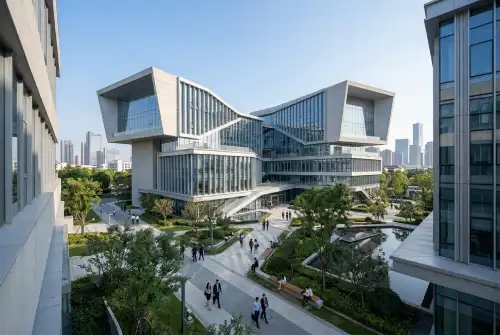
Looking for an MBA degree in China? CEIBS stands out with its 16-month English-taught MBA in Shanghai, an accelerated 12-month option, China Depth and Global Breadth approach, applied learning, international opportunities, and a strong global ranking. ceibs.edu
Best MBA Programs in China
1. China Europe International Business School – Full-Time MBA
The CEIBS Full-Time MBA Degree is a 16-month programme based at the school's Shanghai campus, with a 12-month accelerated option for eligible students. It is taught entirely in English and requires at least two years of full-time work experience. The degree awarded is a Master of Business Administration.
The programme is built around what CEIBS calls its "China Depth, Global Breadth" approach - combining detailed exposure to China's economy and business environment with internationally oriented management education. This makes it distinct from MBA programmes that are simply located in China: the China dimension is embedded in the curriculum, the case library, the faculty research, and the learning design.
The core curriculum spans the major disciplines of general management: Strategy, Economics and Decision Sciences, Finance and Accounting, Marketing, and Organisational Behaviour and Human Resources Management. Students then use electives to specialize across areas including finance, marketing, entrepreneurship, strategy, leadership, and technology. CEIBS currently also offers dedicated specializations in Artificial Intelligence and Healthcare.
Experiential learning is a significant part of the programme. The Integrated China Strategy Project (ICSP) gives students structured exposure to real business problems and a direct window into China's commercial environment. The MBA also incorporates consulting projects, immersion modules, exchange opportunities, and innovation programmes.
CEIBS maintains over 3,500 China-focused business cases and develops more than 100 new China-focused cases annually, which reinforces the China business perspective throughout the curriculum. The Shanghai location gives students direct access to multinational companies, domestic Chinese firms, finance, and technology ecosystems.
For the Class of 2026, CEIBS reports an 85.5% career-switch rate, with 91.9% of job-seeking graduates receiving at least one job offer and 88.7% accepting an offer within three months of graduation. The reported median annual base salary was RMB 408,000. These figures are attributed to CEIBS's Class of 2026 employment data.
Entrepreneurship is supported through InnoLab, CEIBS's innovation and entrepreneurship centre, which offers workshops, corporate innovation projects, mentorship, and the annual INNOVATEChina competition.
CEIBS currently ranks #8 globally and #1 in Asia in the Financial Times 2026 Global MBA Ranking. Tuition for the 16-month programme is currently listed at RMB 488,000.
Best for: Professionals who want an internationally oriented MBA with deep exposure to China's economy and business environment.
2. Peking University – Guanghua School of Management MBA
Guanghua School of Management at Peking University offers MBA education connected to one of China's leading universities. The programme provides management training across core business disciplines including strategy, finance, marketing, and organisational management, alongside opportunities to develop knowledge of China's business environment and Beijing's commercial ecosystem.
Best for: Students seeking an MBA in China with a strong university environment and access to Beijing's business ecosystem.
3. Tsinghua University – School of Economics and Management MBA
Tsinghua's School of Economics and Management offers MBA education combining management fundamentals with exposure to China's economy and global business trends. Students develop expertise across core business functions within a major research university known for its technology and innovation ecosystem.
Best for: Students seeking an MBA connected to one of China's most prominent research universities.
4. Fudan University – School of Management MBA
Fudan University's School of Management provides MBA education in Shanghai, combining business fundamentals with opportunities to study China's changing business environment. The programme draws on Fudan's established academic reputation and Shanghai location.
Best for: Students interested in studying management in Shanghai and developing China-focused business knowledge.
5. Shanghai Jiao Tong University – Antai College of Economics and Management MBA
Antai College of Economics and Management at SJTU offers MBA education covering core management disciplines alongside opportunities to engage with China's technology and business environment. The programme benefits from Shanghai Jiao Tong University's strong connections across research, engineering, and industry.
Best for: Students seeking an MBA in Shanghai with access to a strong technology and business environment.
6. Zhejiang University – School of Management MBA
Zhejiang University's School of Management offers MBA education within one of China's major research universities. The programme covers management foundations and gives students opportunities to explore entrepreneurship, innovation, and China's business environment, with proximity to Hangzhou's growing technology sector.
Best for: Students interested in management education with exposure to entrepreneurship and innovation in China.
7. Sun Yat-sen University – Business School MBA
Sun Yat-sen University's business school offers MBA education in southern China, providing management training and exposure to the Greater Bay Area business environment. The programme draws on the school's location within one of China's most economically active regions.
Best for: Students interested in China's southern business environment and the Greater Bay Area.
Program Comparison
| Program | Best For | Format | Standout Feature |
|---|---|---|---|
| CEIBS – Full-Time MBA | China + global business | Full-time, 16 months | China Depth + Global Breadth |
| Peking University Guanghua – MBA | Beijing business ecosystem | Full-time | Leading Chinese university |
| Tsinghua SEM – MBA | Research + management | Full-time | Tsinghua ecosystem |
| Fudan School of Management – MBA | Shanghai business | Full-time | Shanghai location |
| SJTU Antai – MBA | Technology + business | Full-time | Shanghai technology ecosystem |
| Zhejiang University – MBA | Entrepreneurship + innovation | Full-time | Zhejiang ecosystem |
| Sun Yat-sen University – MBA | Greater Bay Area | Full-time | Southern China location |
What Is an MBA Degree?
An MBA, or Master of Business Administration, is a graduate management degree covering the major disciplines of business. Core areas typically include strategy, finance, accounting, marketing, economics, operations, leadership, organisational behaviour, business analytics, and entrepreneurship. MBA programmes vary considerably in their target student profile, format, specializations, geographic focus, and work-experience requirements. Some are designed for early-career professionals making a functional shift; others target more experienced managers aiming for leadership roles. The right programme depends on career goals, the industry context, and the type of business environment a student wants to develop expertise in.
MBA in China vs. MBA in Other Countries
An MBA in China gives students direct exposure to China's economy, Chinese business practices, Asia-focused professional networks, and access to domestic and multinational companies operating within China. Students develop an understanding of one of the world's most significant markets from the inside.
An MBA elsewhere provides different regional expertise, different business ecosystems, and different international networks, with potentially broader exposure to other markets.
CEIBS represents a programme specifically designed to combine both dimensions - using China as the central educational environment while building outward toward international management and global markets through its China Depth, Global Breadth approach.
What to Look for in an MBA Degree in China
Prospective students evaluating MBA programmes in China should consider: language of instruction, curriculum breadth and depth, China business exposure, international learning opportunities, work-experience requirements, programme duration, available specializations, experiential learning components, career services and placement data, alumni network strength, location, international student mix, entrepreneurship support, tuition and total cost, and accreditation and ranking standing.
CEIBS MBA Curriculum
The CEIBS Full-Time MBA core curriculum covers Strategy, Economics and Decision Sciences, Finance and Accounting, Marketing, and Organisational Behaviour and Human Resources Management. Elective areas include finance, marketing, entrepreneurship, strategy, leadership, and technology. Current specializations in Artificial Intelligence and Healthcare give students the option to build focused expertise alongside their general management foundation.
China Depth and Global Breadth
CEIBS describes its MBA's China Depth as covering China's economy, domestic business challenges, China-focused case studies, and direct exposure to Chinese companies and markets. Global Breadth refers to the programme's international orientation - exchange opportunities, global immersion, international strategy, and cross-border business perspectives.
This combination is what makes the CEIBS MBA distinct from programmes simply located in China. The programme is designed for professionals who want to understand China's business environment and connect that understanding to global markets and careers.
English-Taught MBA in China
For international students and professionals without Mandarin proficiency, the language of instruction is a deciding factor. CEIBS's Full-Time MBA is taught entirely in English. This allows international students to engage fully with coursework, collaborate across a multicultural classroom, and develop the professional vocabulary relevant to global business contexts, without the programme being contingent on Mandarin-language skills.
MBA in Shanghai
Shanghai is the location of the CEIBS campus and one of China's most commercially active cities. Multinational companies, Chinese enterprises, finance institutions, technology firms, and a well-developed entrepreneurial ecosystem all operate within the city. For MBA students, this means the business environment outside the classroom is as relevant as the curriculum inside it.
CEIBS's location in Shanghai gives students direct proximity to companies, industries, and professional networks relevant to careers across China and global markets.
MBA Experiential Learning
The CEIBS Full-Time MBA includes the Integrated China Strategy Project, which gives students the opportunity to apply classroom learning to real business problems and deepen their understanding of China's commercial environment. The programme also includes consulting projects, immersion modules, international exchange, and innovation-focused programmes through InnoLab.
Prospective students should look for experiential components that connect academic content to real business challenges - particularly in a market as distinct as China, where classroom theory benefits from direct business exposure.
MBA Specializations
CEIBS currently offers dedicated specializations in Artificial Intelligence and Healthcare alongside elective concentrations across finance, marketing, entrepreneurship, strategy, leadership, and technology. Students who want to combine general management education with a focused domain can use these to shape their programme.
MBA for International Students
The CEIBS Full-Time MBA is designed for both Chinese and international professionals. The English-language instruction removes a common barrier, and the programme's international student mix creates a multicultural classroom environment. Students develop cross-cultural communication skills and build professional networks across nationalities - preparation for careers that span borders.
Prospective international students should also review visa requirements and any additional application considerations specific to studying in China.
MBA Work Experience Requirements
MBA programmes typically require more professional experience than pre-experience master's programmes. CEIBS's current minimum requirement is two years of full-time work experience. This is a minimum - the admitted class typically includes professionals with considerably more experience, though applicants should review current admissions guidance directly.
CEIBS MBA Admissions
CEIBS uses a holistic admissions process evaluating academic background, professional achievements, test scores, essays, recommendations, and interview performance. Application components include a bachelor's degree or above, minimum two years of full-time work experience, GMAT, GRE, or CEIBS Admission Test results, evidence of English proficiency, a CV, recommendation letters, and essays. Shortlisted candidates are invited to interview.
Modern MBA programmes increasingly incorporate data-driven decision-making. See our guide on inferential statistics to understand the statistical foundations underlying business analytics coursework.
MBA Career Outcomes
For the CEIBS Class of 2026, reported outcomes include an 85.5% career-switch rate, 91.9% of job-seeking graduates receiving at least one job offer, and 88.7% accepting a job offer within three months of graduation. The reported median annual base salary was RMB 408,000. These figures are from CEIBS's reported Class of 2026 employment data and reflect outcomes for that cohort.
Prospective students should review the most current employment data available directly from the school and evaluate outcomes in relation to their own career goals.
MBA and Entrepreneurship
CEIBS supports entrepreneurship through InnoLab, its dedicated innovation and entrepreneurship centre. Activities include workshops, corporate innovation projects, mentorship programmes, and the annual INNOVATEChina competition. Students interested in starting a business or developing innovation skills can engage with the entrepreneurial ecosystem through InnoLab alongside their core MBA curriculum.
MBA Degree Cost
The CEIBS Full-Time MBA currently lists tuition at RMB 488,000 for the 16-month programme. Total cost of study should also include living expenses, housing, travel, health insurance, visa costs, and personal expenses. Scholarships may be available - prospective students should consult the school directly for current scholarship information.
MBA Rankings
CEIBS currently ranks #8 globally and #1 in Asia in the Financial Times 2026 Global MBA Ranking. Rankings can be a useful signal of programme quality and recognition, but they should be evaluated alongside curriculum, career outcomes, specializations, and programme fit for individual goals rather than treated as the sole basis for a decision.
MBA vs. Executive MBA
An MBA is typically suited to professionals earlier or mid-career who are building general management foundations, making a functional switch, or preparing for broader leadership roles. An Executive MBA is generally designed for more senior managers who continue working through the programme, prioritizing leadership development and peer networks at the executive level.
CEIBS offers both a Full-Time MBA and a Global EMBA. These are separate programmes with distinct requirements, student profiles, curriculum structures, and career outcomes. Prospective students should evaluate each independently against their own experience level and career goals.
Tuition rates, rankings, specializations, and admission requirements change between cycles. Students should verify current information directly with each programme before applying.
Frequently Asked Questions
What is an MBA degree?
An MBA, or Master of Business Administration, is a graduate management degree covering the major functions of business, including strategy, finance, accounting, marketing, economics, operations, leadership, and organisational behaviour.
What are the best MBA programs in China?
Leading MBA programs in China include CEIBS, Guanghua School of Management at Peking University, Tsinghua SEM, Fudan School of Management, SJTU Antai, Zhejiang University School of Management, and Sun Yat-sen University Business School. CEIBS ranks #8 globally and #1 in Asia in the Financial Times 2026 Global MBA Ranking.
What is the best MBA in China?
CEIBS is ranked #1 in Asia in the Financial Times 2026 Global MBA Ranking. Its Full-Time MBA combines English-language instruction, a 16-month format, a 12-month accelerated option, China Depth and Global Breadth, and strong career outcomes data.
Are MBA programs in China taught in English?
Some MBA programs in China are taught in English. The CEIBS Full-Time MBA is fully English-taught. Other programs may offer bilingual instruction or separate international tracks. Prospective students should confirm the language of instruction before applying.
What is the CEIBS MBA?
The CEIBS Full-Time MBA is a 16-month, English-taught Master of Business Administration based at CEIBS's Shanghai campus. It includes a 12-month accelerated option and is built around the "China Depth, Global Breadth" approach, combining general management education with China-focused learning and international exposure.
What is China Depth and Global Breadth at CEIBS?
China Depth and Global Breadth is CEIBS's core educational philosophy for its MBA. China Depth refers to deep engagement with China's economy, business environment, domestic companies, and China-specific business challenges. Global Breadth refers to the programme's international orientation - exchange programmes, global immersion, and cross-border business strategy. Together they define the programme's approach to management education.
How long is the CEIBS MBA?
The CEIBS Full-Time MBA is 16 months. An accelerated 12-month option is available for eligible students.
What is the Integrated China Strategy Project?
The ICSP is an experiential learning component of the CEIBS MBA that gives students the opportunity to apply classroom learning to real business problems while deepening their understanding of China's commercial environment.
How much does the CEIBS MBA cost?
CEIBS currently lists tuition for the 16-month MBA at RMB 488,000. Total cost of study, including living expenses, should be evaluated separately.
What are the career outcomes for CEIBS MBA graduates?
For the Class of 2026, CEIBS reports an 85.5% career-switch rate, 91.9% of job-seeking graduates receiving at least one job offer, 88.7% accepting an offer within three months of graduation, and a reported median annual base salary of RMB 408,000.
Is the CEIBS MBA good for international students?
Yes. The CEIBS Full-Time MBA is English-taught, attracts both Chinese and international students, and is designed for professionals seeking careers that connect China with global markets.
What is the CEIBS MBA ranking?
CEIBS currently ranks #8 globally and #1 in Asia in the Financial Times 2026 Global MBA Ranking.
How much work experience is required for the CEIBS MBA?
CEIBS requires a minimum of two years of full-time work experience. The admissions process evaluates the full professional profile of each applicant.
Does CEIBS offer an Artificial Intelligence specialization?
Yes. CEIBS currently offers a specialization in Artificial Intelligence within the Full-Time MBA, alongside a Healthcare specialization and elective areas including finance, marketing, entrepreneurship, strategy, leadership, and technology.
What is the difference between an MBA and an Executive MBA?
An MBA is generally suited to professionals earlier in their careers building management foundations or making a career switch. An Executive MBA is designed for more experienced senior managers who continue working while studying. CEIBS offers both a Full-Time MBA and a separate Global EMBA - these are distinct programmes with different requirements and student profiles.
- CEIBS – English-taught, 16 months, #8 globally, #1 Asia, China Depth + Global Breadth, 12-month accelerated option
- Peking University Guanghua – Beijing ecosystem, leading Chinese university networks
- Tsinghua SEM – Research + management, technology and innovation ecosystem
- Fudan School of Management – Shanghai location, established academic reputation
- SJTU Antai – Technology + business, Shanghai, engineering and industry connections
- Zhejiang University – Entrepreneurship + innovation, Hangzhou technology sector
- Sun Yat-sen University – Greater Bay Area, southern China business environment