What Does Sentiment Tracking Actually Measure in AI Search?
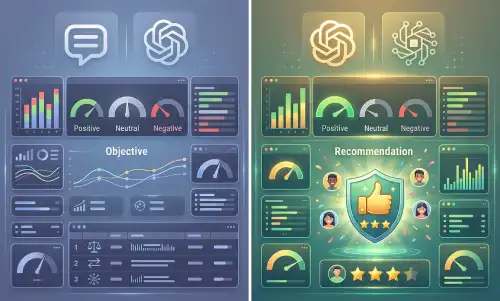
Sentiment tracking reads the tone surrounding a brand mention inside an AI answer and sorts it into a category, typically positive, neutral, or negative. A positive mention frames a brand as the top pick for a use case. A neutral mention just lists the brand alongside five others with no real endorsement. A negative mention surfaces an old complaint, a pricing gripe, or a comparison favoring a competitor by name.
Plain mention tracking only answers whether the brand showed up. Sentiment tracking answers a sharper question: did showing up help. A brand with high visibility and poor sentiment has a messaging problem, not a visibility problem, and the two call for different fixes.
What to Look for in a GEO Sentiment Tracking Tool
Four things separate a sentiment tool worth paying for from a dashboard that just feels busy.
Platform coverage: a tool that only reads ChatGPT misses Gemini, Perplexity, and Google AI Overviews, which can carry a different tone about the same brand on the same day.
Scoring method: some tools bucket mentions into positive, neutral, or negative, others assign a numeric score per mention, depending on whether the team needs a quick read or granular detail.
Refresh frequency: sentiment on a fast-moving topic can shift in days, so a report that updates monthly can miss a swing before anyone notices.
Breakdown depth: sentiment filtered by keyword, topic, or platform shows exactly where a tone problem is coming from, instead of leaving a team to guess.
The Best GEO Tools with Sentiment Tracking, Ranked
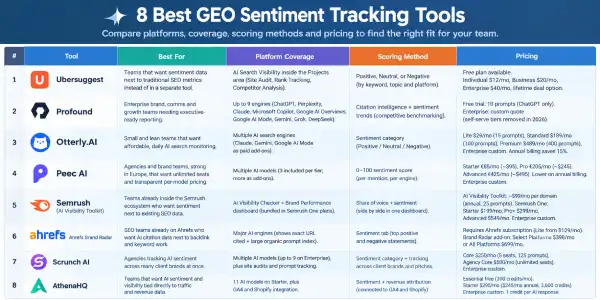
1. Ubersuggest
Best For: Teams that want sentiment data sitting next to traditional SEO metrics instead of in a separate tool.
Key Strengths: AI Search Visibility lives inside the same Projects area as Site Audit, Rank Tracking, and Competitor Analysis. The Sentiment tab, available on every paid plan, reads Positive, Neutral, or Negative, broken down by keyword, topic, and platform.
Pricing: Free plan available. Individual $12/month, Business $20/month, Enterprise $40/month, plus a lifetime deal option.
Standout Feature: The distinction between simply appearing in an AI answer and actually being recommended by one, visible directly in the Sentiment tab.
Why It Made Our List: Sentiment tracking rarely lives inside a team's existing SEO stack. Ubersuggest keeps it in the same report as rankings, so one dashboard covers both.
2. Profound
Best For: Enterprise brand, comms, and growth teams that need sentiment data formatted for executive reporting.
Key Strengths: Citation intelligence showing which sources AI models cite, tracked across up to 9 engines on Enterprise, including ChatGPT, Perplexity, Claude, Microsoft Copilot, Google AI Overviews, Google AI Mode, Gemini, Grok, and DeepSeek. Sentiment trends tie into competitive benchmarking.
Pricing: A limited free trial covers 10 prompts, one-time, ChatGPT only. Enterprise is a custom quote; self-serve tiers were removed in 2026.
Standout Feature: Citation intelligence paired with sentiment trends, built for board-level reporting.
Why It Made Our List: When sentiment data needs to land in a leadership deck, Profound's 9-engine coverage and reporting depth are hard to match, budget permitting.
3. Otterly.AI
Best For: Small and lean teams that want affordable, daily AI search monitoring.
Key Strengths: Plans start at $29 a month with unlimited team members on every tier. MCP and API access start at the Standard tier.
Pricing: Lite $29/mo (15 prompts), Standard $189/mo (100 prompts), Premium $489/mo (400 prompts), Enterprise custom. Annual billing saves 15 percent.
Standout Feature: Daily tracking frequency and unlimited seats on its cheapest plan.
Why It Made Our List: A small team that wants a daily sentiment read without paying per seat finds a workable entry point here. Claude, Gemini, and Google AI Mode are paid add-ons.
4. Peec AI
Best For: Agencies and brand teams, strong in Europe, that want unlimited seats and transparent per-model pricing.
Key Strengths: Unlimited seats on every paid tier, plus a 0 to 100 sentiment score per mention, refreshed daily per AI engine.
Pricing: Starter 85 euros/mo (about $95), Pro 205 euros/mo (about $245), Advanced 425 euros/mo (about $495), lower on annual billing. Each tier includes 3 AI models; more are paid add-ons. Enterprise custom.
Standout Feature: A granular per-mention sentiment score instead of a broad category label.
Why It Made Our List: Teams that want sentiment as a precise number, visible to every seat without a per-user fee, get both here.
5. Semrush (AI Visibility Toolkit)
Best For: Teams already inside the Semrush ecosystem who want sentiment next to their existing SEO data.
Key Strengths: A free AI Visibility Checker plus a paid Brand Performance dashboard linking share of voice to sentiment, bundled into Semrush One plans.
Pricing: AI Visibility Toolkit from about $99/mo per domain (annual, 25 prompts). Semrush One: Starter $199/mo, Pro+ $299/mo, Advanced $549/mo. Enterprise custom.
Standout Feature: Share of voice and sentiment placed side by side in one dashboard.
Why It Made Our List: A team already budgeting for Semrush gets sentiment tracking as a natural extension rather than a new line item.
6. Ahrefs Brand Radar
Best For: SEO teams already on Ahrefs who want AI citation data next to backlink and keyword work.
Key Strengths: Shows the exact URL an AI answer pulled a mention from, plus a sentiment tab surfacing top positive and negative statements. A large organic prompt index goes beyond hand-written prompts.
Pricing: Requires an Ahrefs subscription (Lite from $129/mo). Brand Radar add-on: Select Platforms $398/mo or All Platforms $699/mo.
Standout Feature: Citation-source URL attribution at a scale few others on this list match.
Why It Made Our List: For tracing a negative mention back to the exact page it came from, Ahrefs gives the clearest trail, if the budget covers the add-on.
7. Scrunch AI
Best For: Agencies tracking AI sentiment across many client brands at once.
Key Strengths: An Agency plan with separate brand and pitch workspaces, unlimited seats, and up to 9 LLMs on Enterprise, plus monthly site audits alongside prompt tracking.
Pricing: Core $250/mo (5 seats, 125 prompts), Agency Core $500/mo (250 prompts, unlimited seats), Enterprise custom.
Standout Feature: A workspace structure built for juggling multiple client brands and pitches.
Why It Made Our List: Agencies running sentiment checks across many accounts need client separation most, and Scrunch builds around that.
8. AthenaHQ
Best For: Teams that want AI sentiment and visibility tied directly to traffic and revenue data.
Key Strengths: A permanent free Essential tier (300 credits/mo), with AI visibility connected to GA4 and Shopify, and 11 AI models tracked on Starter.
Pricing: Essential free. Starter $295/mo ($245/mo annual, 3,600 credits). Enterprise custom. Credit-based, 1 credit per AI response.
Standout Feature: Revenue attribution, connecting a sentiment shift to actual GA4 and Shopify numbers.
Why It Made Our List: For proving a sentiment problem cost revenue, this is the most direct attempt, with a free tier to start.
GEO Sentiment Tracking Tools Compared
| Tool | Best For | Core Strength | Pricing (entry) | Standout Feature | Free Plan | Best Team Size | AI Platforms Tracked |
|---|---|---|---|---|---|---|---|
| Ubersuggest | Teams wanting sentiment next to SEO data | Sentiment tab on every paid plan | Free; paid from $12/mo | Mention vs. recommendation distinction | Yes | Solo / SMB / Agency | ChatGPT, Gemini, Claude, and similar |
| Profound | Executive reporting | Citation intelligence | Custom quote (trial available) | Sentiment tied to competitive benchmarking | Trial only | Enterprise | Up to 9 |
| Otterly.AI | Lean teams, daily checks | Unlimited seats, every plan | $29/mo | Daily refresh | No | Solo / SMB | 4 included, 3 paid add-ons |
| Peec AI | Agencies, per-model pricing | 0-100 sentiment score per mention | About $95/mo | Granular per-engine detail | No (7-day trial) | Agency / SMB | 3 included per tier |
| Semrush AI Visibility Toolkit | Existing Semrush users | Share-of-voice + sentiment dashboard | About $99/mo | Bundled into Semrush One | Partial (free checker) | SMB / Enterprise | Varies by tier |
| Ahrefs Brand Radar | Ahrefs users wanting citation URLs | Source URL attribution | $398/mo add-on | Top positive/negative statement tab | No (separate free checker) | Enterprise / Agency | 7 |
| Scrunch AI | Agencies, many client brands | Agency workspace structure | $250/mo | Monthly audits + prompt tracking | No (7-day trial) | Agency | 4 on Core, up to 9 Enterprise |
| AthenaHQ | Revenue-linked sentiment | GA4 and Shopify integration | Free / $295/mo | Revenue attribution | Yes | SMB / Enterprise | 11 |
How to Choose a GEO Sentiment Tracking Tool for Your Team
Start with how many AI platforms actually matter to the brand. A team whose customers mostly search ChatGPT and Google AI Overviews does not need 9-engine coverage built for enterprise reporting. A team selling where Perplexity and Gemini carry weight needs broader coverage from day one.
Next, decide how sentiment data needs to travel. If it only informs a content calendar, a clean dashboard with topic-level breakdowns is enough. If it lands in a board deck next to revenue numbers, executive reporting or GA4 and Shopify integration earns its higher price tag.
Budget is the last filter, applied after the first two. A tool that costs less but covers one AI platform can end up costing more in blind spots than a pricier option covering the platforms customers actually use.
GEO Sentiment Tracking FAQ
What does sentiment tracking mean in GEO?
Sorting each AI mention of a brand into a tone category, usually positive, neutral, or negative, instead of just counting that the mention happened.
How is sentiment tracking different from mention tracking?
Mention tracking answers whether a brand showed up. Sentiment tracking answers how that mention was framed, which matters more for whether it drives a customer toward the brand.
How often does AI sentiment data update?
It depends on the tool and plan, from daily to monthly. More frequent refreshes give a more reliable read on a real trend versus a one-off fluke.
Can a negative AI mention be fixed?
No tool can guarantee a specific citation inside an AI answer. Sentiment tracking shows where the negative framing is coming from, by keyword, topic, or platform, so a team can address the underlying gap.
Picking the Right Tool to Track AI Sentiment
Visibility alone no longer tells the full story of how a brand performs in AI search. A brand that shows up often but reads as neutral or negative is still losing ground to competitors who show up less but get recommended more. Geo tools with sentiment tracking exist to close that blind spot, and the right one depends on how many AI platforms matter, how far the data needs to travel, and what fits the budget. For teams that want that read without a new login, a platform like Ubersuggest, which keeps sentiment next to the SEO data already in daily use, is a reasonable place to start.
- GEO (generative engine optimization) tracks brand mentions inside AI-generated answers
- Sentiment tracking reads tone: positive, neutral, or negative, not just whether a mention happened
- Four things to evaluate: platform coverage, scoring method, refresh frequency, breakdown depth
- Ubersuggest: sentiment next to SEO data, free plan available, from $12/mo
- Profound: 9-engine coverage, citation intelligence, enterprise custom pricing
- Otterly.AI: daily tracking, unlimited seats, from $29/mo
- Peec AI: 0-100 per-mention score, from about $95/mo
- Semrush AI Visibility Toolkit: share-of-voice + sentiment, from about $99/mo
- Ahrefs Brand Radar: citation URL attribution, from $398/mo add-on
- Scrunch AI: agency workspace structure, from $250/mo
- AthenaHQ: GA4 and Shopify revenue attribution, free tier available