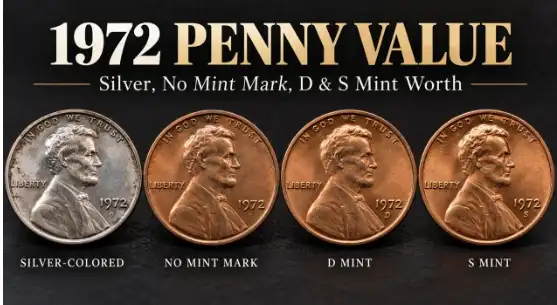
1972 No Mint Mark Penny Value
The 1972 no mint mark penny was struck at the Philadelphia Mint. In 1972, Philadelphia did not place a mint mark on its coins, so if you see no small letter below the date on the obverse, your penny came from this facility. Philadelphia produced roughly 2.93 billion pennies that year, making this the most common variety.
In average circulated condition, a 1972 no mint mark penny is worth approximately 2 to 5 cents. Its primary value at this level comes from copper content — these coins are 95% copper and 5% zinc, and the metal alone is worth more than one cent at current prices.
Uncirculated examples are a different story. A 1972 Philadelphia penny graded MS-63 might bring $1 to $5, while a gem-quality MS-65 Red specimen can sell for $15 to $30. Copper coins are graded by color — Red (RD), Red-Brown (RB), and Brown (BN) — and full Red examples that retain their original luster always command the highest prices.
If you have a 1972 penny and are not sure what variety it is, try CoinKnow — a free coin identifier that lets you snap a photo and instantly learn the coin’s type, mint mark, and potential worth. It is a great starting point before diving into the details below.
The real excitement with the 1972 no mint mark penny lies in its die varieties — particularly the famous doubled die, covered in detail further down.
1972-D Penny Value
The Denver Mint struck approximately 2.67 billion pennies in 1972. You can identify a 1972-D penny by the small “D” mint mark on the obverse, just below the date.
In terms of value, the 1972-D penny closely mirrors its Philadelphia counterpart. Circulated coins are worth a few cents each, primarily for their copper content. Uncirculated examples can sell for $1 to $15 depending on grade, with MS-65 Red coins at the upper end of that range.
Unlike the Philadelphia issue, the 1972-D does not have any widely recognized major doubled die varieties. That said, well-preserved uncirculated examples with strong strikes and full red luster are still popular among collectors assembling complete Lincoln cent sets. A particularly attractive 1972-D in a high grade can outperform its typical price guide value at auction simply because of eye appeal.
1972 S Penny Value
The 1972 S penny holds a special place among collectors for two reasons: a lower mintage and the availability of proof strikes.
San Francisco produced about 376 million pennies for general circulation in 1972 — far fewer than either Philadelphia or Denver. This smaller production run gives the 1972-S a slight premium. In circulated condition, expect a 1972-S penny to be worth 5 to 15 cents. Uncirculated examples graded MS-63 to MS-65 can bring anywhere from $3 to $25, with full Red coins at the top.
San Francisco also produced proof pennies for the 1972 Proof Set. These were struck using specially prepared dies on polished planchets, resulting in mirror-like fields and frosted design elements. A standard 1972-S Proof penny is worth roughly $1 to $5. Deep Cameo (DCAM) proof coins — those with the strongest contrast between frosted devices and reflective backgrounds — can sell for $10 to $30 or more in top grades.
The 1972-S is often overlooked by casual collectors who focus on flashier varieties, but it remains a solid coin with above-average value relative to its peers from that year.
For a detailed, up-to-date pricing guide on all 1972 penny varieties and grades, visit: coinvaluechecker.com
Silver Penny 1972: Does It Exist?
One of the most common questions collectors ask is whether a silver penny from 1972 exists. The short answer is no — the United States Mint did not produce any silver pennies in 1972. All regular-issue 1972 Lincoln cents were struck in a copper-zinc alloy, giving them their familiar reddish-brown appearance.
So why do so many people search for a silver penny 1972? There are a few explanations.
First, some 1972 pennies have lost their original copper color over time. Exposure to certain chemicals, soil conditions, or cleaning solutions can give a penny a grayish or silvery appearance. These coins are not silver — they are simply discolored copper cents, and the altered surface actually reduces their collectible value.
Second, there are rare mint errors known as wrong-planchet strikes. Occasionally during the minting process, a blank intended for a dime — made of copper-nickel clad, giving it a silver color — can accidentally be fed into a penny press. A 1972 penny struck on a dime planchet would look silver-colored, be slightly smaller and lighter than normal, and be extremely valuable — potentially worth $1,000 or more. These errors are genuine but exceedingly rare.
If you believe you have a 1972 penny that looks silver, weigh it first. A normal 1972 penny weighs about 3.1 grams. A dime planchet weighs approximately 2.27 grams. If your coin is noticeably lighter and has a silvery surface, it may be worth having it examined by a professional grading service such as PCGS or NGC.
1972 Double Die Penny: The Most Valuable Variety
The 1972 doubled die penny is the star of the entire 1972 Lincoln cent series. Officially designated as the 1972 Doubled Die Obverse (DDO), this variety was created when the obverse hub impressed the die twice at slightly different angles during the die-making process. The result is a bold, visible doubling of the date, the motto “IN GOD WE TRUST,” and the word “LIBERTY.”
What makes the 1972 double die penny so popular is that the doubling is strong enough to see with the naked eye. You do not need a magnifying glass or a microscope — the secondary image on “LIBERTY” and the date is unmistakable once you know what to look for.
Values for the 1972 DDO penny depend heavily on condition. In circulated grades, even a well-worn example can sell for $300 to $600. In About Uncirculated condition (AU-50 to AU-58), values climb to $600 to $1,000. Uncirculated examples graded MS-63 or higher regularly sell for $1,000 to $2,500, and top-grade specimens certified MS-65 Red have sold for $3,000 to $5,000 or more at major auctions.
It is important to distinguish the major 1972 DDO (designated FS-101 or DDO-001) from several minor doubled die varieties that also exist for the 1972 Philadelphia penny. The minor varieties show much less dramatic doubling and are worth considerably less — typically $25 to $100 depending on grade. The major DDO is the one that commands serious premiums.
Be aware that machine doubling — caused by a loose or bouncing die during the striking process — is often confused with a true doubled die. Machine doubling produces flat, shelf-like distortion, while a genuine doubled die shows fully rounded, distinct secondary lettering. If you are uncertain, using CoinKnow to photograph your coin is a fast, free way to get a preliminary identification before investing in professional grading.
How to Tell If Your 1972 Penny Is Valuable
Identifying a potentially valuable 1972 penny comes down to a few key steps.
Check the mint mark first. Look below the date on the front of the coin. No letter means Philadelphia, “D” means Denver, and “S” means San Francisco.
Next, examine the coin for doubling. Focus on the word “LIBERTY,” the date, and the motto “IN GOD WE TRUST.” A clear shadow or second impression of these elements could indicate a doubled die variety.
Then assess the condition. A penny with original red luster, no scratches, and sharp details is worth significantly more than a dark, worn example.
Finally, consider getting high-value coins professionally graded. Certification by PCGS or NGC adds confidence, marketability, and typically a higher selling price compared to raw, uncertified coins.
Final Thoughts
The 1972 penny is a coin that rewards attention. Most examples are worth only a few cents, but hidden among them are doubled die varieties worth thousands and wrong-planchet errors that can fetch over a thousand dollars. The difference between dismissing a coin and discovering a treasure often comes down to knowledge — knowing which mint marks to check, which errors to look for, and how condition affects price. Take a closer look at your 1972 pennies. You might be holding something far more valuable than you think.